Over the past 20 years, Peter Götzl has transformed his one-man metalworking shop into a high-tech job shop. The company, with its fully automated and digitized sheet metal fabrication, is unmatched in Germany. One passion has guided him on the path to success: laser tube cutting.
In December 2017, a Christmas card from Trumpf landed on Götzl’s desk. It featured St. Nicholas gazing into a futuristic manufacturing landscape—Trumpf’s Smart Factory in Chicago. For many, it’s just a nice greeting; for Götzl, it’s a vision. This is what industry can be like: connected, automated, and high-performing. To see this for himself, he flies to the U.S. shortly thereafter. And he returns with ideas that will reinvent his company, Metallbau Götzl—and himself—once again. But this story begins much earlier. Not in Chicago. But in Erbendorf, in the Northern Upper Palatinate.

© Trumpf
Becoming an Entrepreneur at Breakneck Speed
It’s May 2005. Götzl, just 18 years old, has just earned his master craftsman’s certificate—and immediately starts his own company, a metalworking shop. His previous apprenticeship? Accelerated! His journeyman period? Just two months, followed by master craftsman training. Götzl is practically charging headlong into entrepreneurship.
While others are still figuring out what they want to study, he’s in an acquaintance’s 20-square-meter milling shop, crafting his first railings and fences. State-funded as a “Ich-AG” (one-person business). With little capital, but plenty of drive. Yet for a long time, he was more of a shy boy than a go-getter. At his father’s hotel and in his grandfather’s workshop—his grandfather was a master mechanical engineer—he learned what it means to be an entrepreneur: doing everything yourself, around the clock.
But now, all of a sudden, he has to do more than just get things done: he has to sell, negotiate—and, above all, win people over. Through his interactions with customers and banks, he quickly learns the other side of his early start: Who trusts such a young CEO? “That was the biggest challenge for at least ten years,” says Götzl. His realization: “Experience can only be replaced by hard work. And business only works with quality and on-time delivery.” That’s how the newcomer builds his reputation—order by order—through quick, reliable responses and on-time delivery.
Reaching New Horizons with Laser Technology
After his first in-house facility was completed in 2011 and he hired more employees, a problem arose alongside his success: The more railings or fences he manufactured, the more often he needed custom design components such as railing infills or cap plates. Producing these manually would be very labor-intensive, so he purchases them as laser-cut parts. However, their long lead times do not fit well with Götzl’s business model.
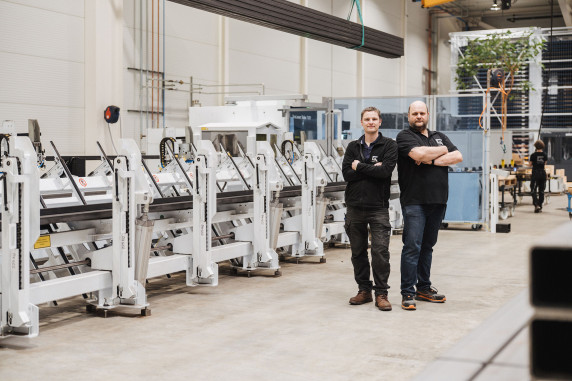
Instead of a solution to the delivery problem, Peter Götzl comes up with a new vision: laser cutting technology. First, he wants to use a flatbed laser to manufacture the purchased design parts himself. Upon request, his Trumpf consultant shows him an even better system—one tailored to his core business: a large Trulaser Tube 7000 laser tube cutting machine. During the demonstration at the Ditzingen Customer Center, Götzl realizes: With this machine, he can cut railings, stairs, and balconies faster and with higher quality than with a band saw or by hand. And gain a competitive edge to attract new customers. However, to install the Trulaser Tube 7000 and operate it profitably, a new facility and additional staff for shift work are needed.
© Trumpf
Sample parts win over skeptics
Thus, the construction of the second production hall in the spring of 2014 marked the beginning of the company’s growth, which continues to this day. Laser tube cutting nearly doubles the production speed and also increases precision. The company transformed from a traditional metalworking shop into a modern contract manufacturing facility. And just as when the company first started, being ahead of the curve had its downside, since not every customer was familiar with laser tube cutting. “Everyone was familiar with milling or turning, but not with laser tube cutting. That’s why I often send out sample parts—they’re very convincing,” says Götzl.
The courage to expand his business model with new technology has paid off. Götzl now supports other laser tube cutting service providers with large orders and manufactures a wide variety of parts—including high-volume runs—for applications such as vehicle swap bodies, high-bay warehouses, seating furniture, and solar energy systems. When the first Trulaser Tube 7000 reached full capacity operating in three shifts, he purchased a second one in 2017. He soon became convinced not only by the machines but also by Trumpf’s service.
Chicago in Erbendorf
At 11 p.m. on a summer night, a laser tube cutting machine suddenly stops working: damage to the laser head. Half an hour later, Peter Götzl has retrieved the part numbers for the necessary replacement parts from the Trumpf online database and ordered them by phone from Trumpf via express shipping. The delivery truck arrives at 5 a.m., and by 6 a.m., the laser is up and running again. “That’s not the only reason we’re convinced by the machine designs, the software, and—above all—the people at Trumpf who are always there to support us,” says Götzl.
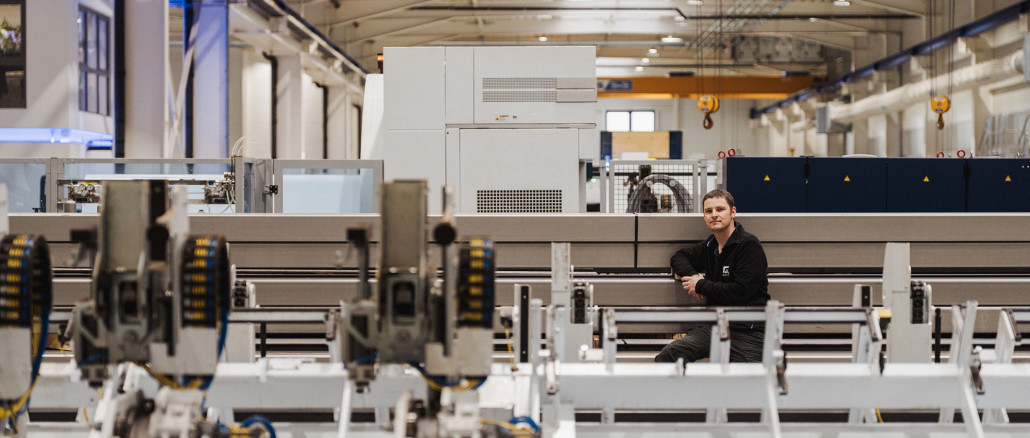
With this statement, we return to “Chicago in Erbendorf,” the vision from 2017. Together with Trumpf, Götzl is planning a cutting-edge sheet metal manufacturing facility. To this end, he is purchasing additional properties, building a third production hall, and expanding his machine fleet to seven laser tube cutting machines, including a Trulaser Tube 7000 with 6 kW of laser power and a 12.5-meter loading and unloading length—a model installed only three times in Germany. “This makes us Germany’s largest laser tube-cutting job shop without our own product line,” says Götzl. Sheet metal production is fully automated and versatile—featuring Trubend bending machines, Trudisk disk lasers, a flatbed laser cutting system (24 kW), and a punch-laser machine—all connected to the Stopa large-scale warehouse system, which supplies the machines with sheet metal and stores finished parts. The Oseon software for material flow and production control also ensures optimal planning and provides the necessary transparency.
Since 2019, Götzl has invested approximately 25 million euros in the project, 12 million euros of which went toward Trumpf machines. Overkill? Not for Götzl: “Production is designed to meet the standards of the next ten years. With more laser power, I can cut faster—even thicker material—which opens up new markets. Plus, customers are increasingly ordering assemblies instead of individual tube parts. We’re ready for anything.” However, he’s not running out of ideas for staying ahead: “We’ve only implemented the basic version of the Chicago model so far. There’s still more to come.”
Web:
www.trumpf.com