
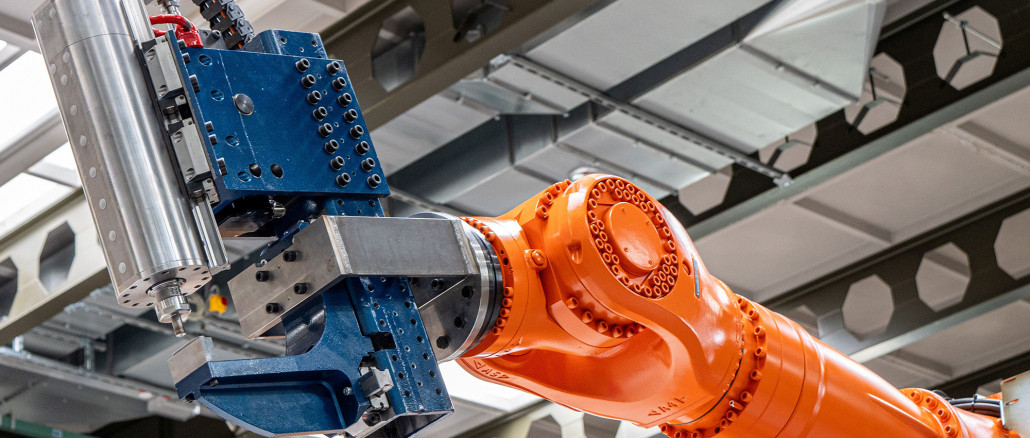
Researchers have succeeded in developing a new form of friction stir welding for flexible, robot-based production lines. The newly developed “Steppwelder” welding gun enables the joining of high-strength aluminum alloys in record time and without heavy external counter holders.
The Technologie Lizenz-Büro er Baden-Württembergischen Hochschulen GmbH (TLB) is now supporting the market launch of the patented new development, according to its own announcement. This is because modern car body construction is under great pressure to innovate: in order to increase the range of electric vehicles, high-strength aluminum alloys and hybrid joints, for example made of aluminum and steel, must increasingly be used. Previous friction stir welding processes often failed in flexible series production due to the massive process forces that required heavy, inflexible counterholders.
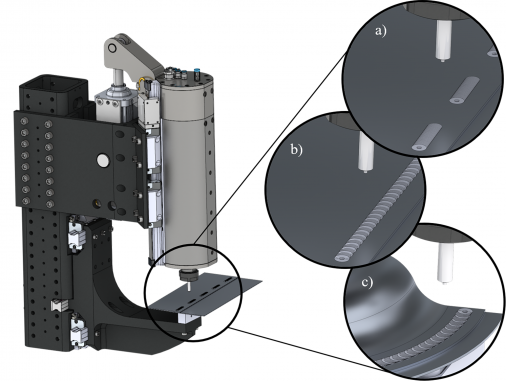
Dominik Walz, MPA, University of Stuttgart
Integrated force flow and the lockstitch principle
The team from the Materials Testing Institute (MPA) at the University of Stuttgart, led by project manager Dominik Walz and inventors Florian Panzer, Stefan Weihe and Dr. Martin Werz, has overcome this obstacle. The core of the new development is a robot-guided welding gun with an actively movable, integrated counterholder. This creates a closed force flow directly in the gun frame, which allows it to be used on conventional 6-axis industrial robots without the need for complex external devices.
A particular highlight is the eponymous “lockstitch seam principle”: by lining up short welds, flexible 2D and 3D sequences can be realized extremely quickly. For example, a 50 cm long seam can be joined in just 1.5 to 2 seconds.
Technical maturity is already well advanced, according to the TLB press release. A complete welding cell for validation tests, including a digital twin, is ready. The project is being funded with around 1.4 million euros through the “VIP+” validation funding program of the Federal Ministry of Education and Research (BMBF). By the end of the validation phase in June 2026, the innovative process should be ready for the market for use in the automotive industry, aviation and mechanical engineering.
Progress in sustainability
In addition to its economic efficiency, the quilting welder scores highly in terms of sustainability: the process does not require any additional materials, produces neither smoke nor spatter and works with minimal energy consumption. At the same time, it enables massive weight savings for complex geometries such as battery housings or megacastings.
The technology is protected by patents in Germany and the USA (DE 102018111496 B4, US 11407606 B2). Technologie-Lizenz-Büro (TLB) GmbH has been commissioned with the commercial exploitation and will offer interested companies licensing and cooperation opportunities from July 2026.