
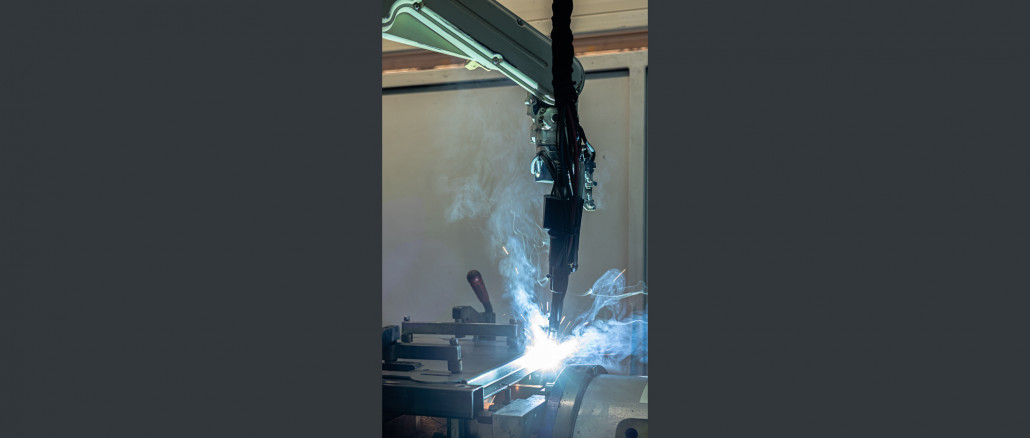
A manufacturer of recycling and waste sorting systems wanted to weld its systems automatically rather than manually and procured a new control system for this purpose. This shortens the welding cycle times and increases the efficiency and scalability of the production line.
Stadler Anlagenbau GmbH from Altshausen in Switzerland has opted for the Tawers G4 welding robot system from Panasonic Factory Solutions. It automates manual welding processes with higher axis speeds and optimized processing performance, as the Japanese robot specialist reports.
Reduced cycle times are a priority
As all systems and components are manufactured in-house, Stadler currently uses Panasonic G3 systems to control all welding operations on the conveyor frame system, pre-assembly and actual assembly. The integrated welding source, the wide process range including MIG/MAG, pulse MAG or CO2 and the Weld Navigation software offer flexibility with stable quality.
The new G4 Welding Robot System optimizes the welding process management in a controller for arc welding. It improves the computing power of the controller, increases axis speeds and optimizes communication between the controller and robot. The touch screen facilitates programming with improved contact tips that combine welding quality and reliability. This eliminates the need for major spare parts storage and minimizes maintenance downtime.
Prior to installation, Stadler carried out simulations and test welds at Panasonic’s Robot & Welding Test Center in Neuss. The employees received expert training on how to use the functions of the G4.
“Panasonic’s robotic welding systems are easy to operate and maintain. As a result, cycle and lead times for some products, including preparation, have been reduced to a third of the original time. With scheduled maintenance cycles, the G4 has proven reliable since its installation. Support is always quick to respond to any queries and provides peace of mind,” comments Bruno Stützle, Production Manager at Stadler.
Virtual production planning and simulation
Stadler uses Panasonic’s offline desktop programming and simulation software (DTPS) on its production line. This enables remote access to the system’s production and operating data in real time and allows the simultaneous planning and simulation of manufacturing processes. This increases flexibility in production and saves time and resources.
DTPS can also input CAD data directly into the production line in various formats. Component geometries can be adapted, while functions such as collision detection, cycle time calculation and welding parameter optimization further improve efficiency.
“Thanks to the offline programming software DTPS from Panasonic, we can simulate and optimize production processes as early as the planning phase. This saves time and reduces the risk of errors and necessary reworking,” adds Stützle.
The acquisition of a third Tawers welding robot system has enabled Stadler to increase its production efficiency. This gives the company the scalability to expand internationally and open up new business opportunities in e-waste and garment recycling.
Web:
connect.panasonic.eu