Cobots make the lives of welding and cutting professionals easier and companies’ production more efficient. The advantages of collaborative robots are of particular benefit to SMEs.
© Fronius
Surveys by market researchers from Fortune Business Insights show that the global market for welding robots will double between 2020 and 2028 – from around USD 5 billion to almost USD 10 billion per year. Cobots and other automated auxiliary devices will account for an ever-increasing share of this, as Messe Düsseldorf reports on the occasion of the Urban Steel Expo from April 20 to 23, 2027.
Cobots are easy to operate
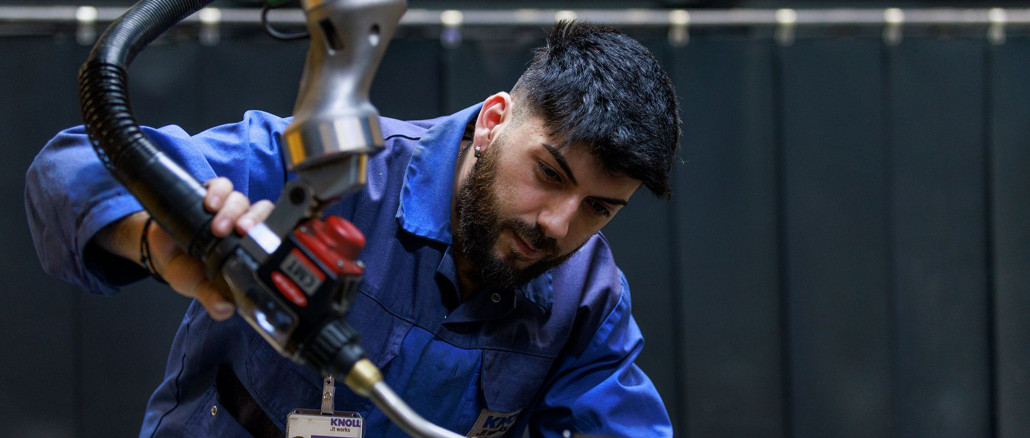
Guide the torch to the starting point, select the appropriate position, set the contour points along the planned weld seam and save the whole thing – and the cobot is programmed. Is it really that simple? The experts at Knoll Maschinenbau GmbH in Bad Saulgau know the answer: “The operation of cobots is intuitive and has a certain fun factor. This is particularly evident among young welders. They think cobot welding is cool – also because it’s as uncomplicated as operating a smartphone,” says Holger Kleck, foreman in the field of welding technology, in support of the new robot colleagues. The company has 1,100 employees and supplies industrial systems to customers in Germany, Poland, China and the USA.

© Xtraction GmbH
The Cobot comes from Fronius, a specialist in welding technology. “The combination of welding technology and technical equipment saves on personnel costs and creates scope for demanding tasks. Cobots not only make welding more economical and safer, but also make the profession more attractive,” says Harald Scherleitner, Chief Sales Officer (CSO) at Fronius International GmbH.
Welding and cutting in one device
A new combination also creates scope: behind the name Xflare is a device that combines welding and cutting on one platform. The company Günthner Metallbau in Eging am See (Bavaria) uses the device – without a break. The company manufactures gates and stairs, railings, canopies and special constructions, among other things. Founder and Managing Director Stephan Günthner speaks of an “incredible reduction in workload”: “We used to have to have components cut externally, but now we do it in-house and can easily save three weeks in delivery time. Switching between welding and cutting is completely straightforward and only takes a few seconds. The weld seams are cleaner and better than by hand and the whole process is much faster. When cutting, you immediately notice how precisely the machine works. With the 5-axis technology, we can even create beams without reworking.”

© Fronius
The device was developed by Xtraction GmbH. What was the intention? “Our aim was to combine the two central processes of metalworking in such a way that they complement each other in everyday use. The 6-axis welding robot and the 5-axis cutting function are coordinated by software that makes it possible to switch between the two processes in less than 10 seconds. At the same time, the Xflare can be integrated into existing production environments and makes companies less dependent on service providers,” says Patrick Fischer, Managing Director of Xtraction GmbH.
Web:
www.use-expo.de