Carbon-free steel—that is the industry’s new goal. While companies in the sector are already reporting on shipments and contracts, in practice the products vary widely, and the road to climate-neutral steel is a long one.
Thyssenkrupp is supplying approximately 1,000 tons of low-carbon Bluemint steel for a water supply project in Angola, while pipe manufacturer Corinth Pipeworks is using low-carbon steel from competitor ArcelorMittal for the first time. These examples show that things are changing in the steel industry. However, steel is not yet completely climate-neutral; manufacturers are focusing first on reducing emissions. This is because producing fossil-free steel requires a complete overhaul of production—a massive undertaking.
CO2 reductions are already possible
Steel manufacturers can already reduce CO₂ emissions to some extent with minimal effort. As part of the partnership between Arcelormittel and Corinth Pipeworks, the steel manufacturer supplies a product called “XCarb recycled and renewably produced.” This is a low-carbon steel produced in an electric arc furnace using at least 75% scrap and 100% renewable energy. This production process reduces CO₂ emissions by 65% compared to the traditional blast furnace route, as reported by Arcelormittel. For hot-rolled coils, the CO₂ footprint of XCarb RRP is 600 kg of CO₂ equivalent per ton—compared to 2,230 kg in conventional production. Long products such as sections or reinforcing steel thus achieve CO₂ emissions of 300 to 333 kg of CO₂ equivalent per ton of finished product. The company is also building a new electric arc furnace at its Gijón site in Spain. The facility, representing an investment of 213 million euros, is scheduled to begin production later this year.
The low-carbon Bluemint steels produced by competitor Thyssenkrupp are based on two different processes. In one variant, the steelmaker reduces the amount of coking coal used in the blast furnace by incorporating pre-reduced—that is, deoxidized—sponge iron. This reduces direct emissions and, consequently, the CO2 intensity of the steel produced in this way by 70%. In the other variant, Thyssenkrupp uses a scrap recycling product in the blast furnace. This also saves coking coal, reducing CO2 emissions by 64%. Thyssenkrupp has had the emission savings verified by the certifiers DNV and TÜV SÜD.

© Thyssenkrupp Steel
Swedish companies are leading the way
Climate-neutral steel has not yet been achieved. The Swedish manufacturer SSAB, a pioneer in the industry, has already succeeded in this endeavor; the “SSAB Zero” steel has been commercially available since March 2023. It is produced from scrap steel using fossil-free energy, with Sweden’s electricity mix—approximately 40% hydropower, 27% nuclear power, and 21% wind power—contributing to CO2 savings. Not included in these calculations are Scope 3 emissions generated by suppliers and during transportation. According to the manufacturer, the final result is that fossil carbon emissions from the production of SSAB Zero amount to less than 50 kg of CO2 equivalent per ton of steel in Scope 1 and 2 of the GHG Protocol. The Swedes also have to admit: The CO2-reduced steel is more expensive.
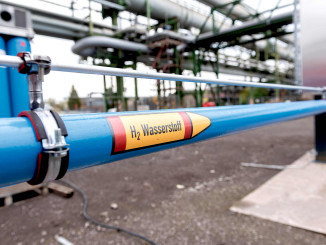
However, this approach has its limitations, as steel recycling cannot meet global demand. To produce fossil-free steel from iron ore, it is essential to replace coking coal with another substance that reacts with the oxygen in the ore’s iron oxide. The key element here is hydrogen. So far, only SSAB has opened a pilot plant in Luleå, in partnership with the mining company LKAB and the energy provider Vattenfall. At the plant, coking coal is replaced by hydrogen produced from fossil-free electricity and water. A process known as direct reduction replaces the conventional blast furnace process. The byproduct is water instead of CO2. Since 2020, the pilot plant has produced more than 5,000 tons of hydrogen-reduced sponge iron. This has allowed the process to be validated, at least on a semi-industrial scale.
Hydrogen will dominate steel production
Despite unresolved technical issues, other steelmakers have jumped on board. For example, Thyssenkrupp Steel has commissioned plant manufacturer SMS Group to build the first hydrogen-powered direct reduction plant at its Duisburg site. This represents one of the world’s largest industrial decarbonization projects, which will enable the avoidance of over 3.5 million tons of CO2 per year in the future. The order volume for SMS exceeds 1.8 billion euros. Completion of the plant, with a capacity of 2.5 million tons of directly reduced iron, is scheduled for 2027. In the meantime, the first support column of the direct reduction tower (DR tower) has been installed. The steel component is approximately 18 m high and weighs just under 70 t.
The direct reduction plant will be commissioned and brought online using natural gas. The proportion of hydrogen will then be gradually increased. Thyssenkrupp Steel’s steel production in Duisburg is set to become climate-neutral by 2045.
Salzgitter is also already working on decarbonization, as Dr. Alexander Redenius of Salzgitter Mannesmann Forschung GmbH explained at the EFB Colloquium in Würzburg. With the Salcos project (Salzgitter CO2-Reduced Steel Production), Salzgitter Flachstahl aims to achieve nearly CO2-free steel production. Starting as early as 2027, more than one-third of Salzgitter Flachstahl’s conventional steel production route—which involves a blast furnace and steel mill converter—is to be replaced by a direct reduction plant combined with an electric arc furnace. The direct reduction plant will initially be powered mainly by natural gas. “This alone will result in CO2 savings of more than 50% compared to the conventional route,” explained Redenius. In addition, green hydrogen will be produced in a 100 MW electrolysis plant. The transformation of the steelworks is expected to be completed by the mid-2030s.

© Itasse
Testing laboratory is preparing new tests
The extent to which the conditions in the new direct reduction process differ from those in the traditional blast furnace process is also evident in Thyssenkrupp Steel’s investment of 2.4 million euros in a new testing laboratory. The metallurgical laboratory in Schwelgern already has testing capabilities for traditional blast furnace feedstocks. The laboratory is now being expanded to meet the new requirements of hydrogen-based direct reduction.
This is because the process conditions in a direct reduction plant differ from those in a blast furnace process. While blast furnaces are characterized by CO-rich process gases and temperatures exceeding 1,000 °C, the direct reduction process operates with hydrogen-rich gases at temperatures of approximately 1,000 °C or less. The pellets and lump ore must therefore be tested to determine whether they tend to stick or clump during reduction, how strongly they tend to disintegrate during reduction, and how well they can be reduced. The latter is a decisive factor for plant productivity, as it directly influences the reaction rate in the reduction process.
Web:
www.thyssenkrupp-steel.com
www.arcelormittal.com
www.ssab.com
www.sms-group.com
www.salzgitter-ag.com