
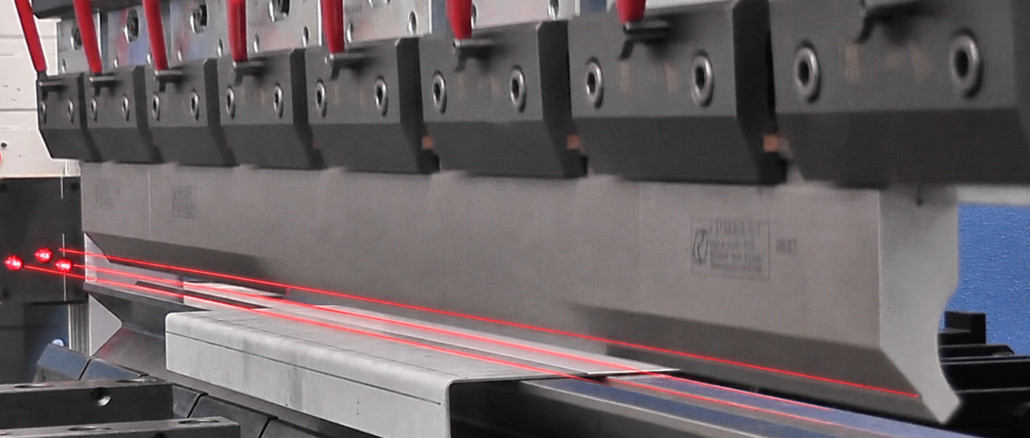
Efficiency and safety are often at odds in metalworking. While high closing speeds increase throughput, they also raise the risk and often lead to complex safety systems that slow down the workflow. This is where a new safety system for press brakes comes in.
A risk analysis shows that the bend line is the most critical point during the bending process. Depending on the workpiece geometry and material, the operator’s hands are often in close proximity to the hazard. Three factors make this particularly challenging:
The variety of materials ranges from matte surfaces to highly reflective, oily sheets.
The geometry involves an alternation between flat material and box-shaped parts.
The dynamics sometimes cause rapid engagement or unintentional slippage during the closing motion.
The combination of box-shaped components and dynamic movements is particularly challenging—this is where conventional safety systems often reach their limits.
Laser beams instead of a light curtain
The Akas 5 system from Fiessler Elektronik solves this dilemma through a combination of a laser transmitter and a pixel array receiver. Unlike conventional light curtains, Akas uses parallel laser beams. This is essential because reflective tools and sheet metal can reflect conventional light, leading to misinterpretations. The Akas system eliminates these reflections and guarantees seamless detection.
To maintain efficiency, Akas offers 5 different safety modes. In flat-bending mode, an upstream safety field detects interference in a timely manner. This allows the press to operate at full speed (rapid stroke) up to the clamping point. Box-bending mode, on the other hand, provides protection for complex parts. When bending box sections, the horizontal safety zone is reduced to allow the process to proceed. To ensure safety nonetheless, Akas switches between a vertical safety zone—which detects body parts at the bending line earlier—and optimized speed, while adjusting the transition point from high speed to low speed. The shorter stopping distance at low speeds eliminates the risk of injury, even if a finger enters the area just before the bend is completed.
Automatic Readjustment During Tool Change
In conventional systems, a tool change often requires manual adjustments. With the Akas 5, the senders and receivers are equipped with electric motor-driven supports. A single push of a button is all it takes for the system to adjust to the new die height. Optionally, the fully automatic adjustment can also be triggered via the press brake’s NC control.
Web:
www.fiessler.de