Support for digital process chains in sheet metal fabrication is the focus of the new version of Lantek’s software suite. New features for bevel cutting, nesting, bending processes, and quote calculation, as well as collaboration and AI projects, aim to improve process reliability, resource efficiency, and a seamless flow of information.
Digital manufacturing processes in sheet metal fabrication are evolving into end-to-end process chains that integrate design, work planning, manufacturing, and order management. With version 45 of its software suite, Lantek is expanding several applications for CAD/CAM, cost estimation, and bending planning. These developments are complemented by an automation partnership with the machine manufacturer Tecoi and a research project on agent-based artificial intelligence.
© Lantek
Enhanced functions for bevel cutting
Bevel cutting is becoming increasingly important in sheet metal fabrication because weld edges can be created during the cutting process itself, eliminating subsequent processing steps. Furthermore, bevels allow for larger weld areas and, depending on the application, contribute to the strength of the joint.
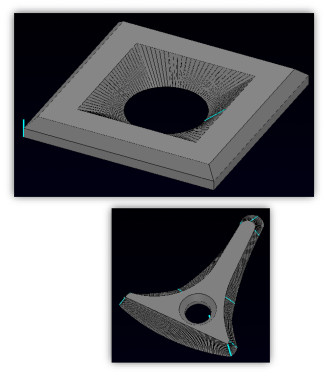
The drawing module has been expanded in version 45 of Lantek Expert. Users can now combine both standard and three-dimensional chamfers on a single part. This makes it possible to design workpieces with edges of different types within a single model.
Another new feature concerns the cutting of Y-chamfers. The system automatically checks whether adjacent workpieces with shared bevel edges can be machined in a single operation. If so, the distance between the parts is adjusted. This reduces material usage, machining time, and scrap. This feature complements the economy cut function for V-seams, which has already been introduced.
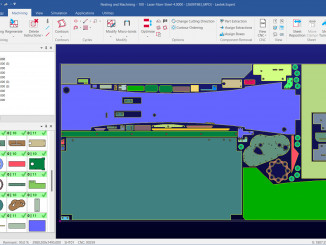
Another enhancement relates to automatic nesting. Previously, components could only be placed according to a predefined rotation grid. In the future, it will also be possible to define a rotation tolerance.
For example, if a 180° rotation is planned, a tolerance of 2° allows for the additional positions 178° to 182° and 358° to 2° to be considered in 1° increments. This creates additional placement options, particularly for smaller laser-cut parts, which allow for better material utilization.

© Lantek
Cost Estimation Based on Real Production Data
The process of preparing quotes is also becoming a greater focus of digitalization. While cost estimates have traditionally been based on experience, spreadsheets, and personal expertise, the demands are increasing due to short response times and competitive pressure.
The Lantek I-Quoting software therefore incorporates data from actual production into the quote. This is based, among other things, on information regarding material utilization, nesting strategies, machine runtime, and production history. To estimate costs, the software combines rule-based methods with process-specific calculation models and—provided sufficient data is available—machine learning methods.
If only a limited amount of historical data is initially available, the system operates using predefined business rules. As the database grows, the accuracy of the calculations can be improved. The goal is to reduce the variance between calculated quote prices and subsequent production costs, as well as to increase the consistency of the quotes.
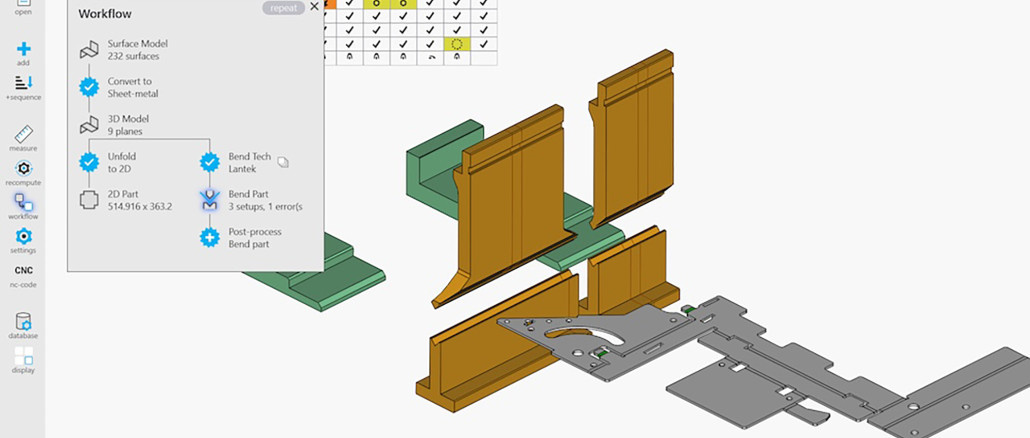
With Version 45, the Lantek Bend bending module was also integrated into the software suite. This allows data to be exchanged between design, cutting planning, the bending process, manufacturing execution (MES), and ERP systems without any manual intermediate steps.
Users can import 3D models either through Lantek Expert or directly into Lantek Bend. There, the system performs flattening, bending simulation, and plausibility checks. The system automatically recognizes different types of bends and incorporates the appropriate tools into the simulation.
For its calculations, the software uses, among other things, material data, tool parameters, and customer-specific empirical values. The calculations are based on the finite element method (FEM). In addition, tool libraries and datasets for various machine and tool configurations are available. The generated manufacturing data is stored in the software suite and is available to downstream applications.
CAD/CAM Software Controls Robots
Lantek has also partnered with machine manufacturer Tecoi to develop an automated system for unloading and palletizing cut sheet metal parts. The system is part of Tecoi’s Sortec project.
While the cutting process continues, a servo-controlled crane transports the material to robots equipped with adaptive grippers. The CAD/CAM software controls the removal of workpieces and organizes the components according to their geometry and orientation. Identical parts are palletized together, which supports traceability and material flow in downstream processes.
The modular architecture makes it possible to integrate additional robotic units and adjust material throughput.
Beyond software development, Lantek is participating in the Galaxia research project in collaboration with the Ikerlan Technology Center. The goal is to develop an agent-based AI architecture that not only analyzes industrial processes but can also coordinate and execute them autonomously.
The project is funded under the Basque Hazitek program and aims to enable companies to achieve greater technological independence while addressing the requirements of the European AI Act. In addition to Lantek and Ikerlan, companies from the retail, automation, security technology, and industrial manufacturing sectors are participating.
The architecture is based on specialized AI agents that collaborate to perform tasks such as analysis, planning, monitoring, and execution. Potential applications range from automated quote generation and image processing to supporting recurring industrial processes. In this context, artificial intelligence is primarily intended to handle standardizable and analytical tasks and to support specialists in planning, monitoring, and decision-making processes.
Web:
www.lantek.com