Laser research is changing: as the laser has established itself as a manufacturing tool, many processes have matured. The key question now is how efficiently, robustly and economically lasers can be used in day-to-day production.
Productivity is therefore one of the most important aspects of research work at the Fraunhofer Institute for Laser Technology (ILT). This does not simply mean higher processing speeds, but a combination of throughput, process stability and reproducible quality. Significant gains are rarely achieved through isolated technological leaps. Rather, they result from the combination of processes, the parallel execution of steps and the scaling of approaches. Less unproductive time and more effective use of resources often have a greater impact than the optimization of individual parameters.
Productivity means more than just higher performance
Productivity in laser technology cannot be reduced to laser power and feed speed alone. It is reflected in the overall process: short cycle times, low non-productive times, minimal reclamping, little or no reworking and stable quality. A process is only productive if it runs reliably without the need for manual adjustments.
At the same time, one prerequisite has changed. Laser energy is no longer a scarce or expensive resource in many applications. High-power sources are widely available and additional watts often add little to the overall cost of the system. The decisive factor is therefore not how much power is available, but how efficiently it can be converted into productivity. Only if the laser source, beam guidance, process strategy and system integration are coordinated can the power be converted into higher throughput.
Laser combination processes as a lever for productivity
Laser combination processes are the supreme discipline in this context, as they ideally enable smooth interaction between all processes. They combine approaches in which several processing steps are carried out within one system, in a closely coordinated sequence or even simultaneously. The core idea here is a more productive overall workflow. By integrating previously separate steps, such concepts can shorten conventional process chains, reduce interfaces and handovers and avoid repeated set-up or re-clamping processes.
This integration has two direct effects on productivity. Firstly, it reduces unproductive times: fewer transfers between machines, fewer intermediate checks, fewer subsequent corrections. Secondly, it allows laser energy and process time to be used exactly where they create added value, instead of being lost through transitions, waiting times or redundant processes. In many cases, the productivity gain results less from pushing a parameter to its limits and more from designing the process flow so that each step builds efficiently on the previous one.
Parallelization: more effect in the same time window
Running processes in parallel is one of the most direct methods of increasing productivity. This shortens cycle times and makes better use of energy, equipment and working time.
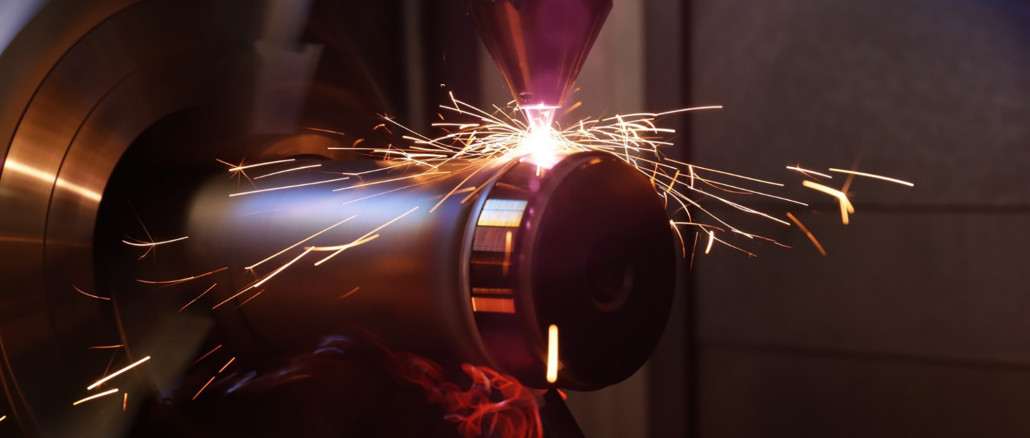
One example is Scarb (Simultaneous Coating and Roller Burnishing): The process combines high-speed laser coating (EHLA) with roller burnishing in a single work step. While the applied coating is still warm, a roller tool moves over the surface, compacting it and smoothing roughness peaks.
The Smac (Simultaneous Machining and Coating) process, which combines mechanical processing with EHLA in a single step, is based on a similar approach. Also developed at the Fraunhofer ILT, Smac solves a fundamental problem of high-strength protective coatings: The harder the coating, the better the protection, but the more complex the post-processing. The special feature of Smac is the use of the residual heat generated in the EHLA process.
High-power ultrashort pulse laser for surface processing
In addition to parallelization, the scaling of processes improves productivity. Many laser processes only become economically attractive when they can be transferred to larger areas or higher throughput. This change can currently be seen in ultrashort pulse lasers (USP lasers).
For a long time, ultrashort pulse technology was primarily associated with precision and low material stress. Today, USP lasers are becoming available in the kilowatt range. Applications that were previously limited by long processing times are now moving into a range that is relevant for manufacturing.
However, higher output alone does not automatically lead to higher productivity. The decisive factor is how this power is applied to the workpiece. Beam shaping, beam deflection and process strategies are essential in order to distribute the energy efficiently and avoid heat build-up or instability.
Acceleration through new process principles: Optical stamping
In many applications, productivity is not limited by the laser itself, but by the way in which energy is transferred to the surface. Scanning strategies are extremely flexible and precise, but when large areas or repetitive microstructures are required, scanning quickly becomes the dominant time factor.
Optical stamping offers a different approach here. Instead of scanning a structure point by point or line by line, a spatial light modulator shapes the beam in such a way that an entire pattern is transferred to the surface with a single laser pulse. Complex microstructures can thus be created in a single step.
This concept is understood as a laser combination process in which the optics, laser source and process strategy are linked together. Productivity gains are not achieved by increasing speed, but by replacing many steps with one interaction.
Hybrid manufacturing: The laser as part of an integrated overall process
The idea of combining processes goes far beyond laser-laser interactions. In many cases, the greatest increases in productivity can be achieved when laser-based processes are integrated into conventional manufacturing processes.
One example of this is the production of hybrid tools. Large basic bodies are produced using the casting or forging process. Functional areas such as cooling channels or locally reinforced areas are then added using additive manufacturing. The overall production time is reduced as additive processing is limited to those areas where it offers added value. The use of materials becomes more efficient as alloys are only used where they are needed. At the same time, tool performance can be improved without increasing overall complexity.
From individual steps to integrated systems
In many cases, the greatest productivity gains are not achieved by optimizing a single process step, but by redesigning the entire process chain. Laser-based process chains offer an alternative approach to established manufacturing, as a research project at the Fraunhofer ILT shows. The scientists use laser processes that range from shaping and material removal to surface finishing and structuring. Digital planning and simulation link these steps from the outset to ensure that each process is coordinated with the next.
This approach reduces interfaces between processes and minimizes manual intervention. At the same time, digital control enables reproducible quality across the entire process chain. In this context, the combination of laser processes replaces long sequences with a digitally controlled workflow.
Common success factors across all approaches
Regardless of whether productivity gains are achieved through parallelization, hybrid manufacturing or new process principles – the success factors remain the same. Laser processes only become productive if they operate within stable and well-understood process windows. Without this stability, higher speed or greater integration merely increase variability instead of creating added value.
Monitoring and control therefore play a central role. In-situ sensor technology, real-time data evaluation and closed control loops help to keep processes in the optimum range even under changing conditions.
A “design-for-laser” approach is just as important. Components and process chains must be designed with the laser in mind right from the start. In this context, artificial intelligence is becoming increasingly important in laser technology. Data-driven methods support process optimization, the selection of parameters and predictive maintenance. Used correctly, they increase robustness and reproducibility. Productivity thus results from the interaction of hardware, software and process design within a system.
Transferring concepts from laboratory demonstrations to robust and scalable production environments requires engineering experience, system understanding and collaboration with industry. Processes must prove that they can work reliably over long periods of time, tolerate fluctuations in materials and components and can be integrated into production lines.
AKL – International Laser Technology Congress
These developments are part of the program of the 15th AKL – International Laser Technology Congress, which will take place in Aachen from 22 to 24 April 2026. The AKL brings together experts from industry and research to discuss current topics and trends in laser technology in production.