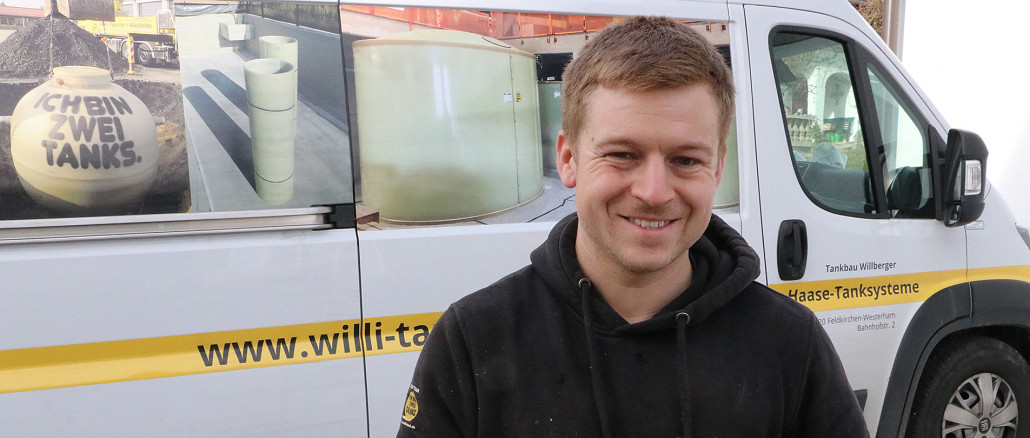
You can’t do it without a heavy-duty drill: Tankbau Willberger from Feldkirchen has been dismantling and installing tanks in private homes and industrial buildings for over 30 years. Hand tools from Trumpf have always played a decisive role in demolition.
© Trumpf
Whether a steel tank holds more than 100,000 liters or only 1,000 liters does not matter to Tankbau Willberger. According to company boss Christian Willberger, the principle of dismantling is always similar: first of all, the construction site is set up. This means that vehicles are positioned for removal, covering fleeces are laid and, if available, windows are opened. Then the tank has to be opened, all pipes removed, the residual liquids pumped out and the tank cleaned with a binding agent. The actual dismantling then begins and the building is left swept clean at the end.
For the Willberger demolition teams based in Feldkirchen, Upper Bavaria, the procedure is a daily routine. They dismantle more than 600 tank systems every year – around half of which are made of steel. And there is no end to this business in sight for the Managing Director: “Tank dismantling accounts for around 50% of our turnover, and I believe this will continue to be a solid business for the next 20 to 30 years. Just as important is the construction of tank systems and heat and cold storage tanks – primarily for private individuals. We are also increasingly installing oil and grease separator systems for industry.”
The basis for all business areas is the good reputation built up over the past 30 years by the specialist company, which is certified in accordance with the German Water Resources Act (WHG). “We want to keep it that way, which is why we see every single construction site as advertising on our own behalf,” explains Willberger. Good manners among his employees are therefore just as important to him as specialist training, tank assembly certificates and ADR certificates, which teach construction team leaders in particular how to handle hazardous goods correctly. He also believes that high-quality tools are essential.
© Trumpf
Quality as the basis for success
Willberger has had experience in this business since he was a child – in the truest sense of the word. His father Albert – who founded the company in 1994 – gave him his first “overalls” when he was just three years old. He worked in the family business while at school and studying economics and finally joined the company permanently in 2019. Today, he runs the business together with his father, but still usually lends a hand himself with one of the three to four demolition teams.
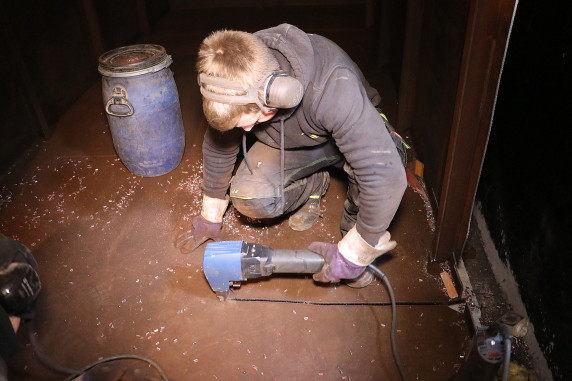
Demolition orders for oil and diesel tanks make up the lion’s share of Willberger’s dismantling sector. This example is no exception: a 22,000-liter oil tank needs to be dismantled. All the preparations have been completed, so now it’s time to crush the tank. To do this, the workers cut open the corners with reciprocating saws, cut through weld seams and struts and then use the Trutool N 700 nibbler from Trumpf.
Gloves on, ear protection on, and two to three nibblers are in operation at the same time in different places. The boss himself also works with an N 700 and reports that he enjoys it more than office work: “It’s just great when the nibbler works its way through the sheet metal, which is up to 7 mm thick, almost by itself, without any great effort. At the end of the day, we can immediately see the result of our work.” Willberger has a total of 20 nibblers in use – fourteen N 700s, five N 500s and one N 1000. The latter is used when particularly large tanks are coated with epoxy resin. Otherwise, the N 700s are the favorite.
Nibblers are productive, safe and odor-free
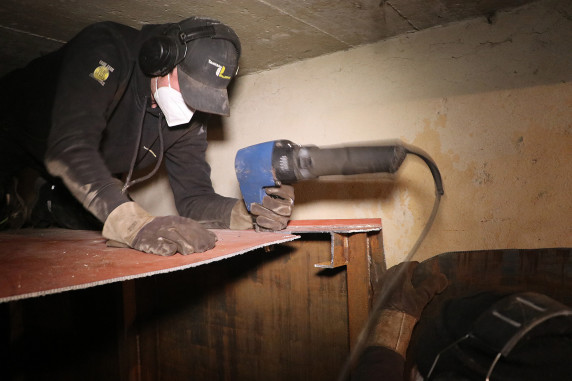
Willberger highlights three advantages: productivity, work safety and freedom from odors and emissions. At 7.7 kg and with an ergonomic handle, the N 700 is easy to handle and has an optimum weight-to-force ratio. He also highlights the one-handed adjustment option in all four cutting directions and the high working speed as helpful. According to the manufacturer, the N 700 achieves speeds of up to 1.3 m/min. These are values that are not verified by the workers. However, they are certain that they are at least four to five times faster than with reciprocating saws.
“In my opinion, angle grinders and cutting torches are also significantly slower than our nibblers. But I can’t say that for sure, because we don’t use these tools at all,” says the Managing Director, citing a lack of work safety and unpleasant smoke and odors. This stench would drift directly into living spaces, especially in private homes.
There is an additional problem with large and medium-sized tanks like the one we have today. It is installed in an existing cellar, which has been used to the maximum. As a result, there is only a little more than the prescribed 40 cm of space all around. It would not be safe to use cutting torches or angle grinders here. The possibility of a broken window cannot be ruled out and the flying sparks are also unpleasant. “Problems that don’t exist with the thick sheet metal cutters. The air stays clean, the risk of injury is low and we can dismantle this 22,000-liter oil tank in half a day with our six-man team,” says Willberger confidently.
Durable technology and easy to service
The technical basis of the Trutool N 700 is a 1700 W drive and a stable tool head. Willberger reports: “We still have nibblers from 1995 in stock. Of course, they are no longer as powerful as the new ones, but they still work perfectly as a backup.”
The primary wear parts, the square punch and the die, also have a long service life. “We can regrind the punches several times, so we can dismantle five to ten tank systems before we have to replace the punch and die,” says the demolition contractor.
Willberger also emphasizes that Trumpf is interested in suggestions for improvement and also responds to them. This is because one – albeit rare – reason for motor damage was the ingress of chips through the ventilation grille into the motor. “I told the German sales manager at Trumpf Elektrowerkzeuge, Philipp Herwerth, about this years ago. The ventilation grilles on our most recently purchased N 700 models are now more closely meshed. This has solved the problem.”