

Optical coherence tomography: Users now have more options for automated weld seam testing during LI arc welding. Ein Hersteller für die Qualitätsüberwachung von industriellen Schweißprozessen erweitert sein Angebot um ein neues Sensoriksystem.
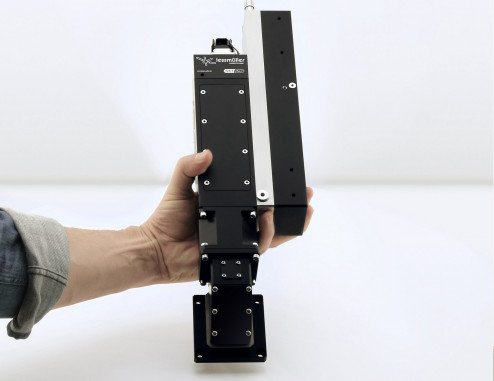
Lessmüller Lasertechnik GmbH, Munich, has launched the OCT 250 stand-alone sensor system onto the market. It uses optical coherence tomography (OCT) as a measuring method for continuous seam tracking and weld seam inspection in real time for automated MSG welding processes.
In this method, broadband light, which has a short coherence length, is split into two partial beams using a beam splitter. One partial beam is directed onto the sample, the other partial beam passes through a reference path. The light reflected from the sample is superimposed with the reference light in an interferometer and thus caused to interfere. The interference signal can then be used to distinguish different structures along the optical axis, i.e. in depth. Three-dimensional images are obtained by scanning laterally across the sample. The bandwidth of the light source determines the axial resolution. For example, a superluminescent diode as a light source with a central wavelength of 1325 nm and a bandwidth of 97 nm has a coherence length of approximately 16 μm The OCT resolution in the axial direction is then equal to half the coherence length, in this example therefore 8 μm.
© Lessmüller
More precise than conventional cameras
According to Lessmüller, the advantages for users are obvious: OCT processes are more precise than conventional camera technology, the effort required for subsequent quality control is significantly reduced and the user software also enables the evaluation and documentation of analysis data. Productivity increases and waste can be reduced.
Arc welding, or GMA welding (gas metal arc welding), is widely used. It enables the joining of thin sheets as well as components with material thicknesses of up to 60 mm and is often used fully automatically and robot-guided in industrial environments. In order to improve the productivity of automated GMA welding and to reduce rejects caused by insufficient fusion of the welded joint, the welding process must be precisely controlled. Due to the high demands of robot-guided MSG welding, previous process monitoring systems – using a laser projector and CMOS camera – are often considered inadequate. OCT technology now enables appropriate quality assurance in arc welding for the first time.
More accuracy and better tracking
Similar to laser beam welding, the OCT 250 stand-alone welding sensor system also enables upstream seam tracking and downstream seam inspection during the welding process in automated MIG welding. In contrast to conventional process monitoring systems with camera technology, the OCT sensor is insensitive to light. Despite the arc, ambient lighting and reflective weld spatter, it works reliably and precisely. This insensitivity makes it possible to place the measuring lines much closer to the TCP (Tool Center Point) and thus reduce passive travel distances, i.e. non-productive times.
The OCT scanner can be mounted directly on a robot-guided welding torch. For process monitoring, the system projects two OCT scan lines close to the welding area. The first, running in front of the tool tip, captures the geometry to be welded and, if necessary, measures the dimensions of the gap. The second scan line runs behind the torch nozzle, i.e. after the arc, and scans the weld bead. Quantitative and qualitative data such as weld seam length, profile, width, area and throat of the weld bead, convexity and concavity of the seam surface, undercuts and other defects as well as porosities and craters on the surface are recorded.
Software corrects ongoing welding process
The user software developed by Lessmüller itself allows all data for quality assurance of seam tracking and inspection to be visualized, evaluated and archived for tracking purposes. The client software can issue control commands to the machine or robot controller via fieldbus based on the preceding seam tracking and correct the robot’s program sequence. For example, offsets, the welding angle or a combination of both can be adjusted and individually adapted to the respective joint type as well as the gap and overlap size. The evaluation of the subsequent seam inspection allows comparison with predefined tolerances and, if critical faults are detected, can mark the components as rejects and even abort the welding process. This eliminates the effort and need for additional quality checks after welding.
The OCT 250 stand-alone sensor system is a very efficient, space-saving and easy-to-integrate process and quality monitoring system for automatically guided GMA welding that pays for itself in a short time. Users can avoid production downtimes, ensure the required welding quality and increase the productivity of their welding processes. Additional control measures can be reduced and working time saved. The reliability and industrial suitability of the system has already been proven in several test applications at research institutes and Tier 1 automotive suppliers.
Web:
www.lessmueller.de