
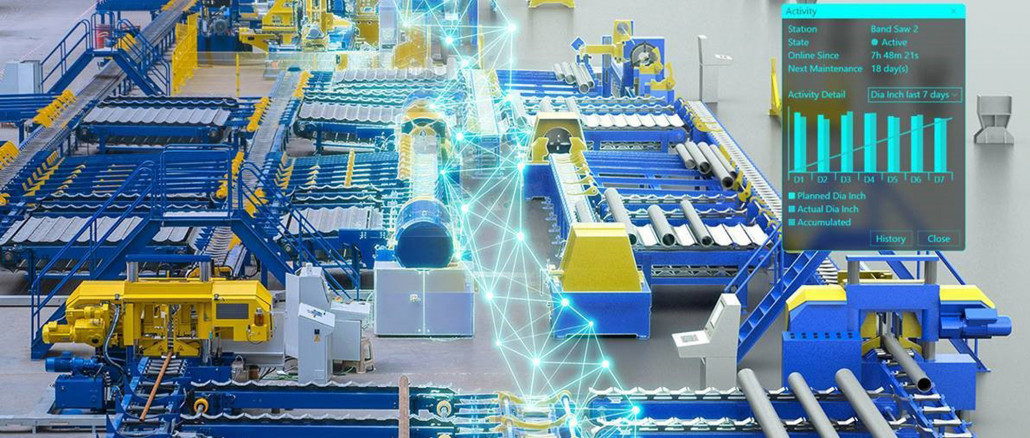
From isometrics to digital process chains in the pipe store: many pipe prefabrication companies are characterized by manual workflows and fragmented processes. Planning, work preparation, production control and quality documentation can be combined into a digital process chain, which can result in major efficiency gains.
Pipes and pipelines are the lifelines of every industrial plant – whether on ships, oil rigs or in production facilities. If the structure, skeleton and hull form the skin, then the piping system is the cardiovascular system: it distributes media and energy and keeps operations running.
Despite this central importance, many pipe prefabrication companies still work with highly manual, labor-intensive processes. Workflows are often fragmented, digital transparency is lacking and machines are selected in isolation rather than as part of an integrated system. However, even the most modern individual machines cannot compensate for inefficiencies in planning, tracking and documentation. The remedy is a continuous, automated process chain that algorithmically optimizes production stations and processing sequences.
From planning to production
As a German software developer with over 40 years of experience in the pipe industry, 3R solutions offers a modular platform that covers all phases of pipe prefabrication – from planning and control through to complete documentation. The aim is to shorten throughput times, reduce material losses and create complete process transparency.
The process begins with the creation of isometric drawings. Design data from 3D systems can be imported or drawings can be created manually. Based on defined rules, these are automatically divided into individual spools. The software immediately generates worksheets, parts lists and production documents.
Interfaces to common 3D platforms and the optional integration of a bending simulation allow designs to be optimized in a targeted manner – for example, by replacing weld seams with bends. This not only reduces production time, but also costs and potential sources of error.
Intelligent work planning
Released spools are combined into structured work packages in Ramp (Resource and Activity Management for Piping). This central planning tool can be integrated into ERP systems and project schedules and takes into account material availability, priorities and actual production capacities.
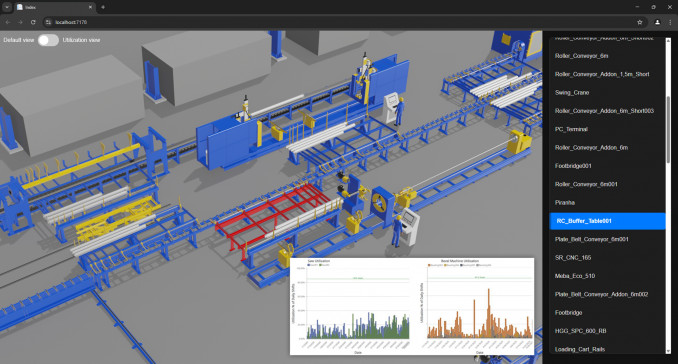
Ramp works with detailed information on stations and machines – including material suitability, cycle times and throughput times – and thus enables data-based, realistic route planning. Automatically generated call-off lists and routing plans systematically guide each pipe from station to station. The system also calculates the optimum sequence of welding seams and processing steps and assigns them to suitable machines. Technological dependencies are taken into account based on rules.
Paper-based worksheets are replaced by digital station interfaces. Operators can see at all times which work steps need to be carried out and feedback flows back into the system in real time. This creates complete traceability throughout the entire production process.
© 3r Solutions
Full automation with APSC
For highly automated pipe shops, 3R solutions offers APSC (Automated Pipe Shop Control). This control level connects the work packages planned in Ramp directly with the physical handling and transport systems in the workshop.
Processes such as conveying movements, transfers or pipe separations are triggered automatically – without manual intervention or operator input. The result is a consistently coordinated, largely unmanned production environment with maximum process reliability.
End-to-end traceability
Jointcheck completes the digital process by documenting every single welded joint. Batch and certificate numbers, personnel IDs of fitters, welders and inspectors as well as all relevant inspection results are recorded. The assignment of spools to inspections can be automated – for example, project-dependent, performance-based or via statistical random samples for NDT. This ensures that quality requirements and regulatory specifications are reliably met.
Final and progress reports can be created both for internal purposes and for external partners such as classification societies or end customers. Authorized stakeholders can even track the project status in real time via read-only access.
Measurable benefits in practice
Users of the 3R software – especially in combination with pipe workshops planned by 3R – report significant improvements: shorter throughput times, fewer welding errors, less rework and smoother acceptance procedures. The savings are particularly evident not only in production itself, but also in planning, coordination and documentation. For example, 3R customers have reduced the time required for work preparation and planning by up to 50% by using the software, and have also achieved significant savings in production.
Pipe prefabrication is facing a fundamental change: while the focus has often been on individual machines or production islands in the past, the focus is increasingly shifting to the end-to-end organization of the entire process flow. Digital platforms that link design, work planning, production control and quality documentation enable a new form of transparency and controllability in the pipe store.
The decisive advantage lies less in the automation of individual work steps than in the systematic optimization of the entire process chain. If isometrics are automatically transferred to spools, work packages are realistically planned, machine capacities are taken into account and processing sequences are algorithmically optimized, throughput times can be significantly shortened and sources of error reduced. At the same time, seamless traceability of all manufacturing and testing processes is created, which is becoming increasingly important for both internal quality requirements and external approvals.
Practical reports show that the greatest effects are not only achieved in production itself, but above all in the upstream planning and coordination processes. If work preparation is consistently supported digitally and linked to workshop control, considerable time and efficiency gains can be realized. Digital process chains are thus becoming a central building block for economical, transparent and future-proof tube production structures.
3r Solutions at Tube 2026: Hall 5 A12
Web:
www.3r.de