

Industrial automation systems are now being given a new foundation. AI and simulation are penetrating all areas – from planning to virtual commissioning and operation.
The aim is to optimize processes at an early stage, reduce risks and accelerate the implementation of automation projects, according to Kuka. Simulation is developing into a key pillar of industrial automation. According to Global Market Insights, the global market for digital twins reached a volume of USD 13.6 billion in 2024 and is expected to have grown to USD 18.9 billion by 2025. Forecasts predict a market volume of over 400 billion US dollars by the mid-2030s. This is primarily due to applications in manufacturing, automation and virtual commissioning. Simulation is now developing into a strategic lever across the entire automation life cycle.
© Kuka
Simulation as a new core component
Together with Visual Components, part of the Kuka Group since 2017, Kuka is driving forward industrial simulation in engineering, planning, commissioning and life cycle management. “Simulation is no longer an optional engineering tool – it is a strategic competence,” says Christoph Schell, CEO of the Kuka Group. This puts the company in a position to reduce risks, shorten time-to-market and tap into new efficiencies.
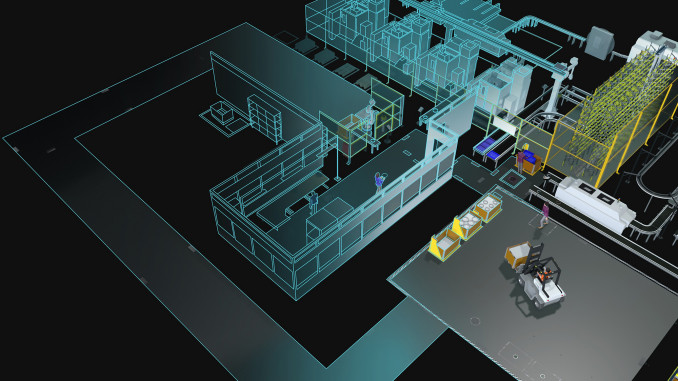
A simulation event at Kuka’s headquarters in Germany demonstrated this focus, which is supported by Visual Components’ partners such as Twinzo, Riiico, Dualis, Realtime Robotics, Flexcon and Team CMC in industrial simulation. Visual Components plays a key role: its simulation platform enables high-resolution digital twins, collaborative planning and facilitates decision-making at a very early stage, long before physical systems are built.

© Kuka
Optimizing robot systems before construction
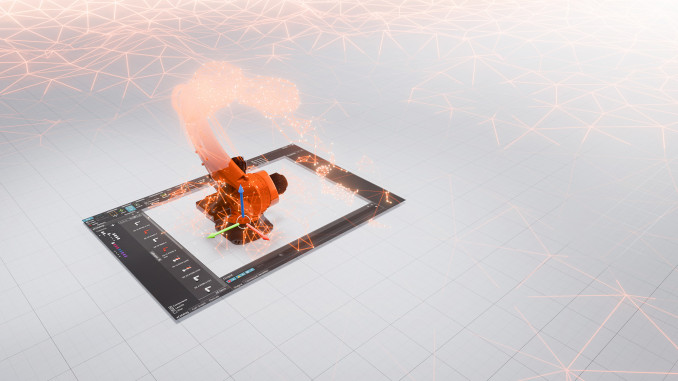
By combining Kuka’s automation with Visual Components’ manufacturing simulation software, production systems can be virtually designed, scaled and optimized with high accuracy and reliability. “This approach enables manufacturers to validate layouts and robot concepts at an early stage, identify bottlenecks and optimize cycle times before commissioning, improve collaboration between engineering, production and management, and reduce changes during installation and ramp-up,” says Mikko Urho, CEO of Visual Components. For the Kuka Group, this represents a step towards predictive, data-driven automation systems.
“One advantage of integrating Visual Components is the better visualization of large investments, which enables a much faster and clearer understanding of the potential of both mechanical automation and digitalization,” says Alexandra Krupp, Director Process Development at Kuka partner Freudenberg Sealing Technologies.
© Kuka
System integrators and customers benefit
System integrators, engineering partners and technology providers are important for implementing simulation-controlled automation at customer sites worldwide. “Working with Kuka and Visual Components in the development of our production cells has improved both our product and process development. Through simulation and data-driven analysis of our production data, Visual Components enables us to shorten development cycles, increase process efficiency and bring products to market faster,” says Dr. Jürgen Fründ, Project Manager Innovation & Digital Transformation at Benteler Automotive Components. Visual Components thus serves as a common platform that enables standardized workflows, faster project execution and closer collaboration across company boundaries.
Matthias Wilhelm, Sales Manager for Germany, Austria and Switzerland at Visual Components, also speaks of an unrivaled level of realism when simulating complete production systems. For end customers, the strategic focus on simulation means greater transparency and confidence in investments in automation. “For us, Visual Components is an important building block within the digital engineering toolchain that we are developing,” says Matthias Vietz, Software Engineer and Product Owner at Bosch Rexroth.
© Kuka
Automation systems make decisions
This foray into industrial simulation is a core element of the Kuka Group’s “Automation 2.0” strategy. For the robot supplier, the term stands for the next evolutionary stage of industrial automation: the transition from individual machines to networked, intelligent and software-controlled production systems. Simulation enables virtualization, data-supported decision-making and optimization across the life cycle of automation systems.
At the same time, the robot manufacturer is driving forward the integration of AI into automation. A Kuka robot stood on stage with Nvidia CEO Jensen Huang at the chip manufacturer’s GTC AI conference. Huang’s keynote speech made it clear that industrial automation is entering a new phase. In manufacturing, AI systems will no longer just analyze and make predictions, but will perceive the physical world, make decisions and act autonomously.
Physical AI and robotics are becoming key factors in manufacturing, supply chains and industrial services – increasing both productivity and competitiveness. This transformation is being accelerated by breakthroughs such as highly scalable AI models that can be extended to ever larger amounts of data, simulation-driven innovation and computing architectures that range from end devices to edge systems and data centers.

© Kuka
Robots can adapt themselves
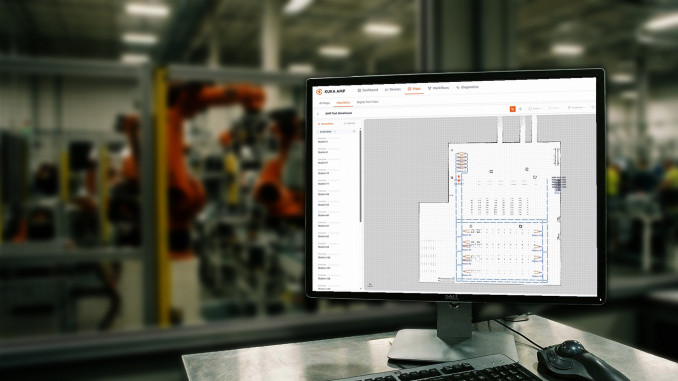
“Robots and automation systems are evolving from programmable machines to intelligent collaborators that can learn, adapt and work safely alongside humans,” says Kuka Group CEO Christoph Schell. With open software platforms such as Kuka AMP, which combine traditional, deterministic automation with intent-based automation, the path from idea to deployment will be faster, more precise, cheaper and more autonomous. Kuka presented its new automation management software platform ‘Kuka AMP’ for the first time at the GTC.
Today, industrial robots are capable of precisely repeating identical motion sequences. However, if conditions change, adaptations often involve configuration effort, specialist knowledge and fragmented tool landscapes. “While ‘AI-first robotics’ can be impressive in laboratory environments, it often fails to deliver consistent results under changing conditions in real production. There, models need to understand and generalize their environment in order to achieve the repeatability required for industry,” says Marc Fleischmann, Chief Software & AI Officer at Kuka Group. The new software platform meets this challenge by standardizing how AI infers, decides and acts in the physical world.

© Kuka
AI agents communicate with robots
At the heart of Kuka AMP is a scalable platform layer between AI agents and hardware. It provides three capabilities to translate higher-level goals into reproducible results on machines: First, semantics, i.e. the “why”. Intent-based processes with a shared semantic context that translates the real world into meaning that machines can understand. This allows AI to focus on results rather than coded device specifics. Secondly, the actions, i.e. the “how”. A standardized control interface with action modules enables AI agents to implement their intentions across different robots, AMRs, work cells and systems. And thirdly, data, the “what”: a structured telemetry pool that records statuses and operating data and enables continuous learning and optimization cycles.
During operation, Kuka AMP will abstract, observe, act, repeat and predict in a closed loop. The software optimizes both the real environment and the digital twin. This creates a self-reinforcing learning process in which each task and each exception improves the next. Kuka AMP is designed as an open, modular API platform that coordinates all elements of automation – from AMR and industrial robots to work cells, software tools and digital services.
© Kuka
Classic automation remains important
With this evolution of the combination of software, programming languages, tools and platforms, the company is adding intent-based capabilities and physical AI to its systems across robotics, system integration, warehouse management, healthcare automation and simulation. Intention-based systems translate a user’s desired outcome into automated decisions and actions. The technology itself determines how to achieve a goal instead of humans dictating every step. Kuka is positioning itself to expand its position in the age of physical AI.
In today’s predominantly rule-based automation, the markets are highly competitive. Long-standing automation customers are reducing their investments. At the same time, customer demand and production locations are shifting. “On the path to Automation 2.0 and physical AI, classic automation remains essential, for Kuka and for the entire industry,” says Schell. “Rule-based automation continues to deliver the stability and productivity that our customers depend on, especially in high-volume and safety-critical environments. We are not replacing it. We are enhancing it with intent-based and AI-driven capabilities.”
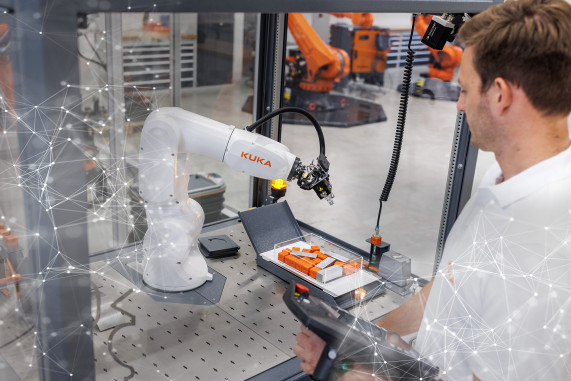
At the same time, technological upheavals and growth potential are attracting investment from a growing number of new and established suppliers of robotics and automation systems. In this environment, the realignment is already reflected in business development: Kuka Group achieved profitable sales growth of four percent in 2025 and recorded an increase in incoming orders.
© Kuka
High investment in R&D for realignment
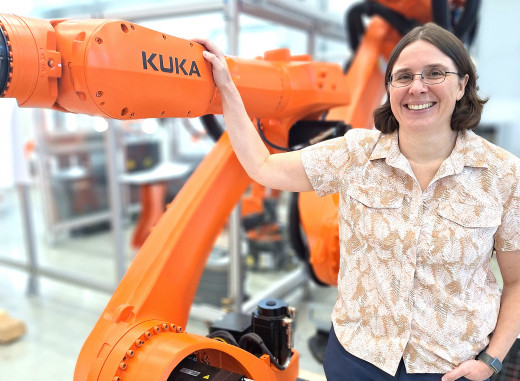
Kuka began its strategic realignment last year after Christoph Schell took over as CEO. “Our growth areas – intelligent automation and software- and AI-defined infrastructures – are developing dynamically. Our modular production platforms are leading the way,” says Schell, adding: “Looking to the future, we expect a decade of profound technological transformation. Cost reductions, software and AI as well as shifts in geographic importance will be decisive drivers for the success of Kuka Group.”
In 2025, the Kuka Group invested 213 million euros in research and development, more than ever before. At the same time, the company is now more globally positioned than ever before: last year, around one third of sales were generated in each of the EMEA (Europe, Middle East and Africa), Americas and Asia-Pacific regions.
China remains the largest robotics market, accounting for more than 50% of global demand. In this environment, Kuka has strengthened its market position and is now one of the two leading suppliers. For the first time in the company’s history, sales in the China business exceeded 1 billion euros.
At the same time, the company is expanding its global presence – most recently with one of several new training, research and application centers in central Vietnam, which was established in partnership with the University of Da Nang. In India, one of the world’s fastest growing automation markets, Kuka is expanding its market presence in order to participate in the country’s growth. In the USA, Kuka has established a Software and AI Center of Excellence in Silicon Valley. The team is led by Marc Fleischmann and includes Melonee Wise, an award-winning robotics pioneer who is now working for the automation group.
Web:
www.kuka.com