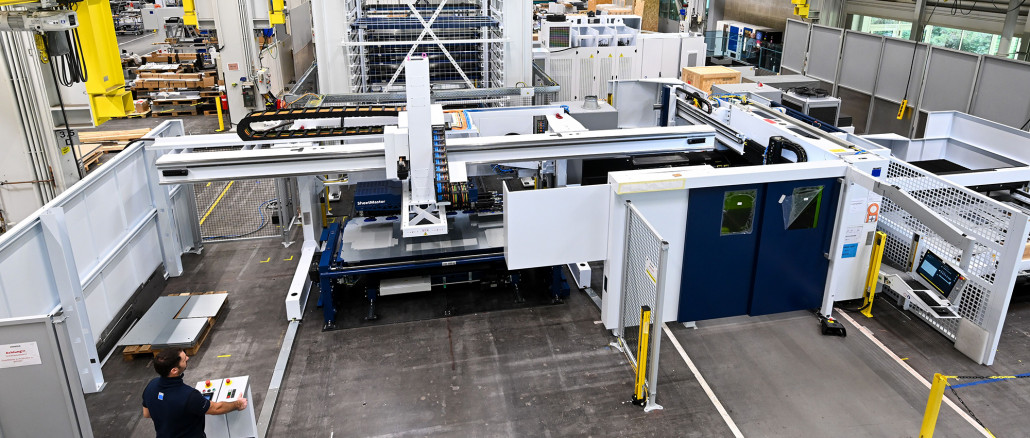
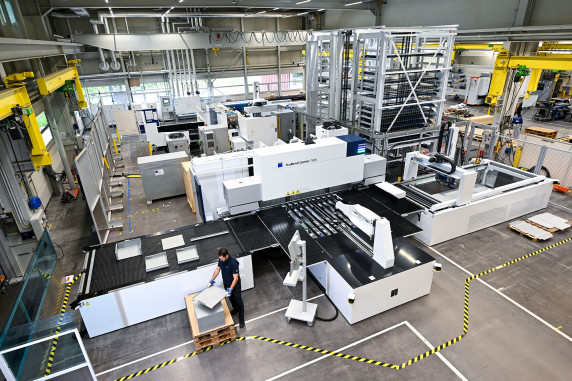
At Blechexpo, Trumpf presented a fully automated, interlinked system consisting of the next generation of the TruBend Center 7030 folding machine, the TruMatic 5000 punch laser machine and the Stopa flex automated storage system for the first time.
Compared to classic interlinked production lines, the solution is particularly flexible. This is possible thanks to the Stopa storage system, which stores the parts between the individual production steps. In this way, Trumpf combines the flexibility of individual machines with the efficiency of production lines.
Stephan Mayer, CEO of Trumpf Werkzeugmaschinen: “An important step towards further increasing efficiency in sheet metal production is the direct linking of cutting, punching and bending – and this with the smallest possible batch sizes right down to one-piece flow. This saves on floor space costs, internal logistics and unnecessary parts inventories. Thanks to the integrated, fully flexible software, new parts can be programmed in the shortest possible time.”
The networked system produces both individual parts and high-volume series economically and efficiently. The decoupling stabilizes the overall system and enables better utilization of each individual machine. In addition, the solution requires only one operator and thus reduces part costs.
© Trumpf
More flexibility through “indirect” interlinking
The classic interlinked production lines on the market work according to the “KIT” principle (continuous production). This means that all components in a series pass through a fixed sequence of process steps one after the other – right up to the end product. Such production systems are rigid and therefore unsuitable for small batch sizes and a high number of variants. The cutting and bending process steps are dependent on each other, which has a negative impact on the productivity of the overall system because the machines have to wait for each other due to different cycle times and sometimes stand still.
Trumpf takes a different approach with its solution. In terms of “batch production”, the first machine in the production system produces a certain number of components. The Stopa warehouse stores these temporarily before the automation transports them to the next machine. With this production technology, the process steps run independently of each other.
This means that even smaller quantities can be produced flexibly – down to batch size 1. “With our solution, users can freely choose their production strategy for each order. This gives them efficiency advantages, for example because they can make their logistics processes more efficient,” says Trumpf Product Manager Sebastian Götz.
Software controls material flow automatically
The interlinked solution from Trumpf is networked via the OSEON software. This not only allows users to flexibly control the material flow, but also gives them complete transparency over production. Rush orders can also be flexibly loaded via the software. As the interlinked solution consists of medium-format machines, it is also particularly compact.
“Our solution gives companies the opportunity to automate their production piece by piece and expand it into a smart factory,” says Götz. The solution is particularly suitable for small and medium-sized companies that want to expand their production capacity. Due to its high level of flexibility, the solution is primarily aimed at product stores, particularly in the areas of elevator construction, refrigeration and air conditioning technology, switch cabinet construction, commercial kitchen construction and store fitting.
Even more productive and cheaper
Among the interlinked machines themselves, Trumpf will be exhibiting a new version of the TruBend Center 7030 folding machine, which is 30 percent faster than its predecessor. This is made possible primarily by the revised manipulation concept and consistently parallel-controlled axes. A rotator and a 2-axis manipulator handle the component particularly close to the bending line. This saves time, especially when several bends are required.
In addition, Trumpf has equipped the new TruBend Center 7030 with an open machine concept without safety fences. This enables the operator to load the machine more quickly and ergonomically. Trumpf guarantees maximum safety with integrated laser scanners that automatically detect foreign objects in the work area. If the system detects the operator in the safe area, the machine switches itself off.
Thanks to the revised machine frame, it is also more attractively priced. The TruBend Center 7030 is suitable for components with a sheet thickness of up to three millimetres and a length of up to three meters.
Interlinked system suitable for a wide range of parts
The TruMatic 5000 punch laser machine, which is also part of the interlinked system, also works productively. Companies can use it to cut, punch and form parts. With its six kilowatt, highly efficient Trumpf fiber laser, it is suitable for a wide range of parts. It also has a ToolMaster for automated tool changes and a Sheet Master, which ensures the material flow between the machine and the warehouse.
© Rohde & Schwarz; Trumpf
Cooperation on drone defense
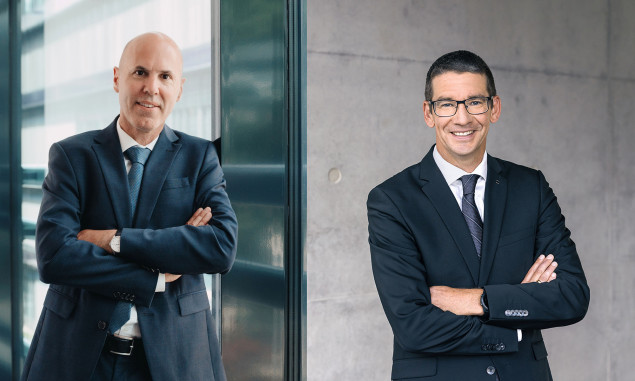
Technology companies Rohde & Schwarz and Trumpf SE + Co KG have announced a strategic partnership to develop and deliver a comprehensive and nationally produced drone defense solution. This collaboration combines Rohde & Schwarz’s drone defense solution in the field of electromagnetics, radar sensor technology and Trumpf’s laser technology.
This will enable detection, tracking and defense against the growing threat of drones on various platforms. The expertise of both companies will provide customers with a defense against drone-based threats. Rohde & Schwarz will integrate Trumpf’s high-energy laser system into a complete drone defense ecosystem.
“We are proud to partner with Trumpf to provide a sovereign solution for drone defense,” said Dr. Alexander Orellano, Head of Technology Systems Division, Rohde & Schwarz. “This collaboration combines the strengths of both companies to address critical security needs. Investment in European defense, and in drone defense technology in particular, is of paramount importance.”
“Our laser technology, our expertise in beam guidance and shaping, and our internally anchored supply chain of system-critical subcomponents provide a highly innovative solution for drone defense,” explains Dr. Hagen Zimer, Trumpf board member responsible for laser technology. “The combination with Rohde & Schwarz’s drone defense expertise enables us to deliver a truly effective and integrated solution to protect critical infrastructure and secure sensitive areas.”
Both companies are aware of the importance of using their technologies purely defensively to overcome the new security risks – a responsibility that they now share.
Web:
www.trumpf.com