
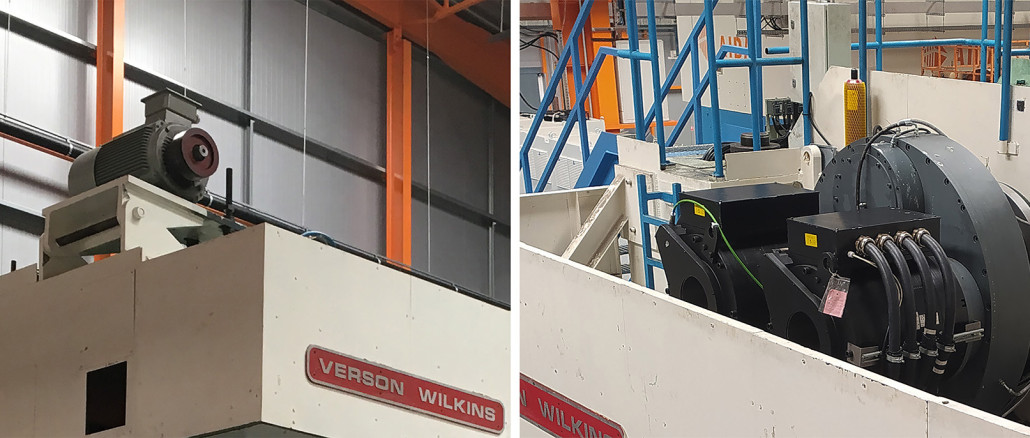
Flexible motion profiles, machine modernization, and drive concepts designed to reduce energy consumption and power requirements were the focus of Baumüller’s exhibition at Euroblech 2026.
Among other things, the company demonstrated a mini servo press in operation at its booth. Baumüller also presented a drive combination consisting of a DST2 high-torque motor and a Servox gearbox from Nidec Desch. The focus was on drive concepts for servo-eccentric presses as well as the retrofitting of mechanical presses. Other key topics included reducing energy consumption and power peaks, as well as the use of recovered energy.
© Baumüller
Adapting Motion Profiles to the Forming Process
Compared to conventional mechanical presses, servo presses allow for more flexible design of the motion profile. This can be adapted to the specific forming process, taking into account factors such as cycle time, die wear, and energy consumption. According to the motor manufacturer, this increases productivity and product quality. At the same time, the elimination of certain mechanical components reduces the number of wear parts and thus the need for maintenance.
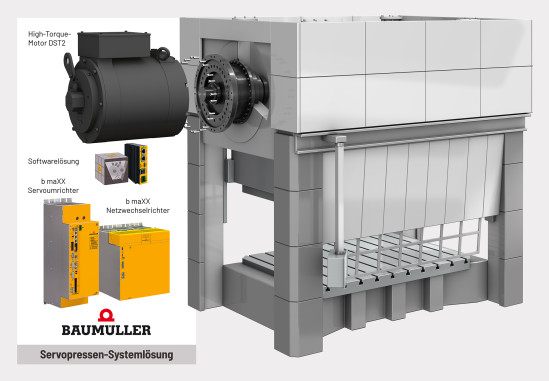
The system designed for servo presses consists of a DST2 high-torque motor, a B Maxx grid inverter, a B Maxx servo drive, control technology, and a software package.
In addition to equipping new machines, servo drive technology is also intended for the modernization of mechanical presses. A flywheel press can be converted into a servo-eccentric press by making modifications to the drive system and the control system. Compared to purchasing a new machine, this can save costs and often time as well.
From a flywheel press to a servo press
After dismantling the drive system and inspecting the mechanical components, DST2 high-torque motors can often be connected to the existing gearbox, as Baumüller explains. Servo inverters and control technology then take over the regulation of the new drive system.
The retrofit also eliminates the need for components such as clutches, brakes, and V-belts. This reduces the maintenance requirements for the modernized machine.
The choice of drive system depends primarily on the product to be manufactured on the forming press and, accordingly, on the machine configuration. The B Maxx series servo drives can be used in various configurations for this purpose.
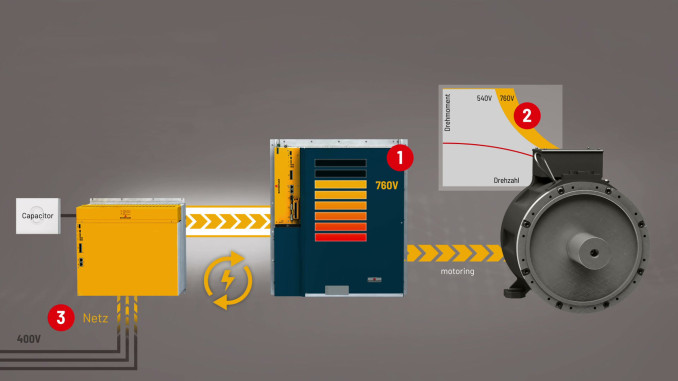
A key element of the drive architecture is a common DC link. This connects the B Maxx grid inverter—which serves as both a power input and feed-back unit—to the B Maxx servo drive. Energy can be temporarily stored in the DC link capacitors. This allows power peaks caused by the conversion process to be absorbed, resulting in a lower electrical connected load. Accordingly, the associated connection costs can also be reduced.
© Baumüller
Using Braking Energy for Subsequent Process Steps
The DC link also enables the use of recovered energy. While individual movements of the press require electrical energy, energy is recovered, for example, during braking after the forming stroke. This energy can be stored in the DC link and subsequently used for a subsequent process step. This reduces the press’s energy consumption from the power grid.
The grid inverter also increases the DC link voltage from 400 to 760 V. This shifts the motor characteristic curve and expands the available speed range. According to Baumüller, this allows for the use of smaller motors in suitable applications.
The grid inverter can feed excess energy from the common bus back into the utility grid. This further reduces energy consumption. At the same time, the braking resistors can be made smaller or, depending on the application, eliminated altogether. This reduces the space required in the control cabinet and lowers its cost.
Web:
www.baumueller.com