With the 44th EFB Colloquium on Sheet Metal Working, the European Research Association for Sheet Metal Working (EFB) in Würzburg has once again created a central forum for exchange between science and industry. According to the organizers, the event was characterized by a very good response from participants and a high quality of technical discussions.
Experts from research, development and industry used the colloquium to discuss current developments, technical challenges and solutions for sheet metal processing. The program made it clear how many parameters the industry is currently working on in parallel. The focus was on issues relating to more climate-friendly material and process design as well as the use of artificial intelligence in production and manufacturing. Discussions included approaches for low-CO2 steel production, the technical consequences of so-called green materials for further processing and the use of generative AI and AI-supported process optimization in the pressing plant. Other presentations were dedicated to sensor-based evaluations in sheet metal forming, strategies for material characterization and validation, adaptive joining processes, data-based machine intelligence and digital twins for production and logistics.
Questions directly on the industry
The colloquium also focused on topics that are becoming increasingly important for industrial practice: the in-line detection of tool wear, regulatory framework issues such as the possible PFAS ban, the evaluation of alloy variations to strengthen raw material resilience and concepts for the circular economy. The contributions on the further processing of end-of-life vehicle sheet metal and production scrap as well as new data-based approaches in forming technology in particular showed how closely sustainability, resource efficiency and technical innovation are linked.
“The colloquium showed how profoundly sheet metal processing is currently changing. From the decarbonization of materials to intelligent processes and the circular economy, it is no longer about individual topics, but about the interaction of many developments. The direct exchange between research, development and industrial application is particularly valuable,” says Dr. Daniel Rosenbusch, Managing Director of EFB.
Award ceremony shows the potential of science
A total of five technical sessions with 18 presentations were on the program. The event was complemented by an accompanying trade exhibition. The EFB’s regular general meeting also took place on the first day of the event.
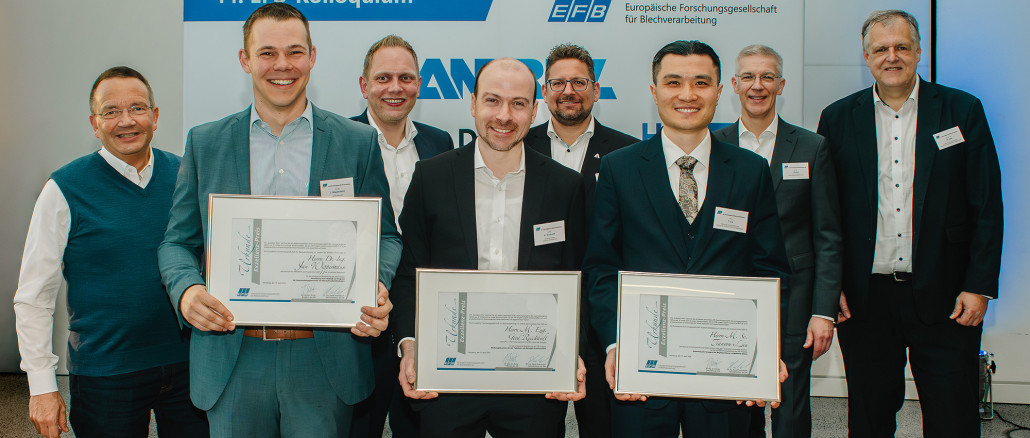
A highlight of the colloquium was the presentation of the EFB Excellence Awards during the evening event. The winners were:
– Dr.-Ing. Jan Wippermann, Laboratory for Materials and Joining Technology (LWF) at the University of Paderborn, for the work “Development of a method for predicting the bolting parameters of sheet metal bolted joints”
– M. Sc. Tianyou Liu, Chair of Forming and Casting Technology (utg) at the Technical University of Munich, for the work “Evaluation of failure in bending operations of pre-stretched sheet metal”
– M. Eng. Gerd Reichardt, Institute of Forming Technology (IFU) at the University of Stuttgart, for the thesis “Tool construction methods for deep drawing with volatile lubricants”
The following morning, the award winners presented their projects in short talks and gave the specialist audience an insight into the scientific approaches, industrial relevance and application potential of their work.
Web:
www.efb.de