
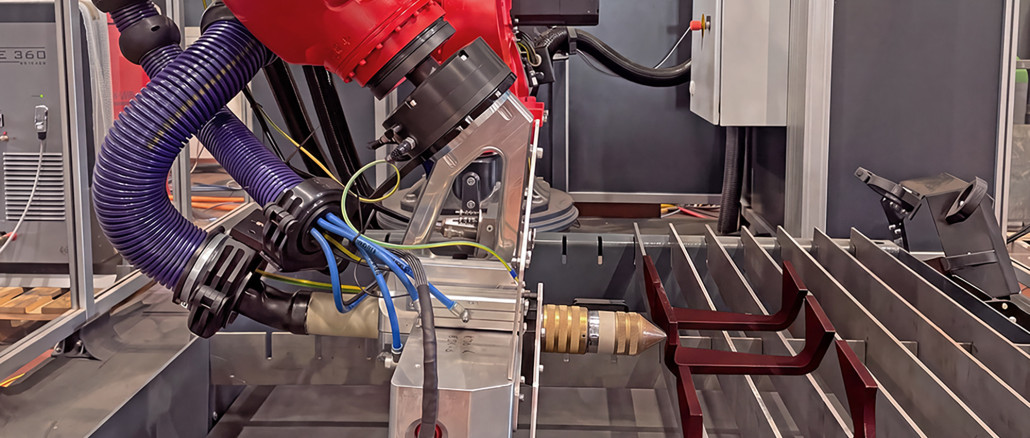
The Biber robotic cutting system now features Biber.next, a software solution for 3D-aided machining. A point cloud of the workpiece is used to capture component geometries, identify collision areas, and calculate collision-free toolpaths.
ERL Automation will present systems for automated cutting and welding processes at Euroblech in Hanover from October 20 to 23, 2026. The highlight of the exhibition will be the Biber robotic cutting system. The company will also showcase the new Biber.next software, which expands the cutting system’s application range to include bent parts and more complex component geometries.
© ERL
Robot Assists with Cutting Operations
ERL Automation has equipped the Biber system with a Kuka Iontec robot, a machine control system, a newly developed operator console, and the Intelliplace camera system. The system is designed for the automated processing of various workpieces. The intended applications include, in particular, bevel cuts for weld preparation as well as 3D cutting tasks.
A key advancement involves the capture of component geometry. While the previous method was based on laser measurement, Biber.next uses a three-dimensional point cloud. This provides a spatial representation of the workpiece’s geometry and thus serves as the data foundation for further path planning.
In addition to flat material, this new process can also be used to machine bent parts and components with more complex geometries. With such workpieces, access from above is often particularly limited. This places additional demands on the robot’s path planning, as component contours and interference zones must be taken into account to prevent collisions during machining.
To achieve this, Biber.next analyzes the point cloud of the workpiece and identifies potential collision areas. Based on this analysis, the software calculates toolpaths that allow the robot to navigate around critical areas. This enables collision-free machining even for geometrically complex workpieces.
The use of three-dimensional part data thus expands the possibilities, particularly for workpieces whose geometry makes machining with conventional measurement technology difficult. The combination of spatial workpiece measurement and automated toolpath planning is designed to support the programming and machining process for parts with varying or complex geometries.
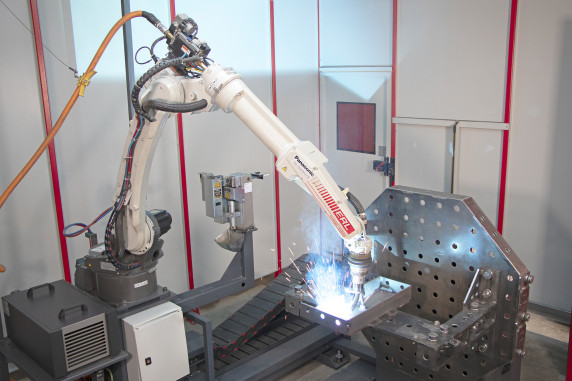
At Euroblech, ERL Automation will not only be demonstrating the Biber and Biber.next robotic cutting systems in action. Visitors will also be able to see a robotic welding cell with integrated control of the robot and welding power source. The focus is on process control, reproducible welding results, reduced non-productive time, and integration into networked production environments.
© ERL
Automated Welding and Cutting Processes
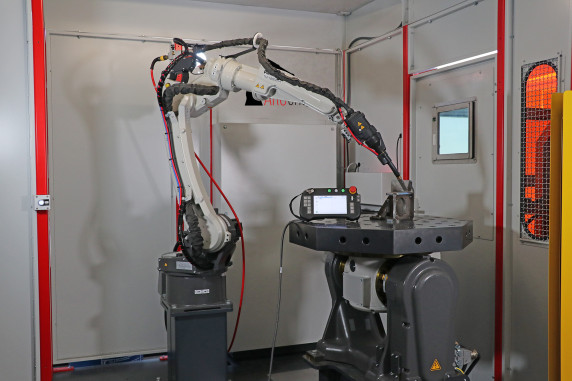
The Arcentre is a robotic welding cell equipped with a Panasonic G4 welding robot and Active Towers 4 technology. A swivel-tilt axis on the welding table allows components to be positioned precisely during the machining process. This makes the system suitable, among other things, for applications requiring positioning synchronized with welding.
The Active-Tawers-4 platform combines the robot controller with the controller for the digital welding power source into a single integrated system. The controller continuously coordinates robot movement, wire feed, and welding process data. This control system ensures a stable arc and reproducible welding results.
Another benefit is the reduction in weld spatter. In CO₂ welding—depending on the application and parameter settings—weld spatter can be reduced by up to 98% compared to conventional methods. Controlling the molten pool also enables flat and uniform weld beads, thereby reducing the amount of post-welding work required.
Panasonic’s G4 generation features advanced path and process control. This allows for a reduction in non-productive and cycle times. Compared to the previous generation, the maximum axis speed has increased by up to 27%.
A touch panel is available for operation. The system can be integrated into networked production environments via an OPC UA interface. Welding processes can be prepared in advance of production using the Panasonic DTPS offline programming system. This allows users to digitally simulate welding sequences and verify their feasibility and efficiency beforehand.
System Configuration Based on Manufacturing Tasks
As a system integrator, ERL develops the Arcentre series of robotic welding systems to meet specific manufacturing requirements. The system on display at the Euroblech trade show can be equipped with, among other things, positioners, workpiece changeover systems, and automated loading and unloading systems. This allows the system configuration to be adapted to different components and production processes.
In addition to the robotic welding cell, the company is showcasing Arcwelder welding machines for MIG, MAG, TIG, and manual arc welding processes. Thus, the company’s exhibition in Hanover covers both manual welding technology and automated robotic welding systems. The robotic welding cell and the Arcwelder units will be demonstrated in operation during the trade show. Visitors will be able to observe the respective welding processes and system functions through practical applications.
EuroBLECH:
Hall 13, Booth D126
Web:
www.erl-cutting.com