
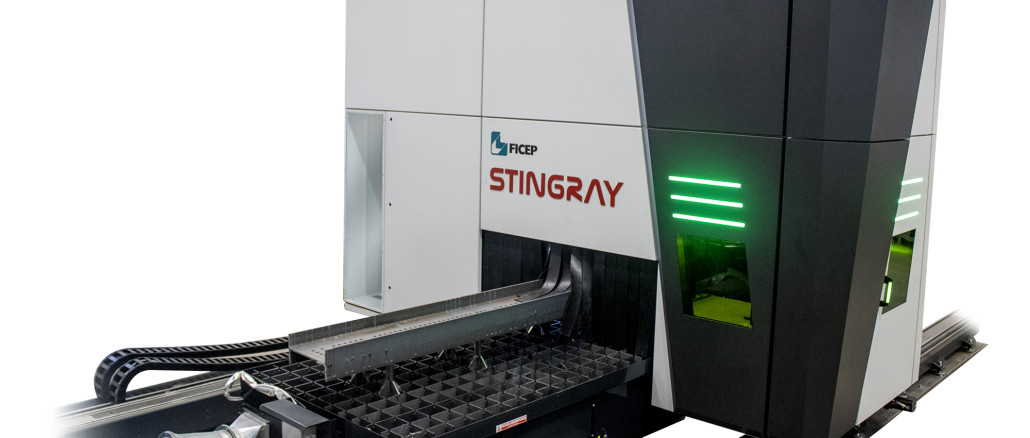
Ficep has introduced a modular approach to steel processing with Make. Standardized machine architectures, hybrid manufacturing processes, and lifecycle services are designed to increase the adaptability and service life of production facilities. To this end, the company first unveiled the Stingray G and Helios G laser systems.
At its open house event, machine manufacturer Ficep presented the Make platform concept. It encompasses the development, configuration, and long-term use of industrial production systems. The goal is to provide manufacturing capacity on demand, reduce implementation costs, and further develop existing systems as requirements change.
With the Stingray G and Helios G, the company is also introducing the first two machines developed based on this concept.
Production systems should not be designed solely to meet the requirements at the time of purchase, but should also take into account future changes in manufacturing tasks. To this end, the concept calls for standardized machine modules and scalable configurations that can be combined, expanded, or adapted to meet specific production needs.
By integrating additional processes and functions, the goal is to ensure that systems can continue to be used even as requirements change. In this way, the manufacturer aims to extend the economic service life of the production systems and reduce the risk of premature obsolescence.
Another key focus is on reducing the complexity of industrial investment projects. Standardized modular architectures are designed to simplify the planning and implementation of manufacturing systems and lay the groundwork for future expansions. According to the manufacturer, this can shorten installation and commissioning times and reduce risks. A simplified system architecture is also intended to help operators become familiar with the systems more quickly.
This gives users the option to start with a machine configuration tailored to their current needs and to retrofit additional functions or capacities as needed. This can be particularly important in cases of fluctuating production volumes or changing workpiece requirements.
© Ficep
Combination of Laser Processing and Mechanical Methods
In addition to its modular architecture, Make provides for the integration of various processing methods. Laser machining enables the production of complex contours and geometries and offers a high degree of flexibility. Mechanical processes such as drilling, on the other hand, offer advantages in certain steel construction applications in terms of hole quality, productivity, and process reliability. The concept therefore calls for combining different processes within a single production system.
Standardized modules form the technical foundation of the platform approach. Standardization ensures consistent manufacturing quality and reliability of the individual assemblies. At the same time, configurable machine layouts allow for adaptation to workpiece ranges, production volumes, and spatial constraints. The modular design simplifies installation and makes future expansion easier to implement.
Through Make, Ficep is also advancing its business model for industrial production facilities. In addition to purchasing machinery, the focus will shift in the future to providing manufacturing capacity. The platform concept is therefore also geared toward service-oriented business models. The plan is to support the systems through lifecycle services, technical upgrades, and long-term support offerings.
This is intended to enable users to adapt their production systems over a longer period of time and maintain their performance. The economic benefits of an investment are thus not assessed solely on the basis of the original machine configuration, but also take into account future expansion and usage options. The company has not yet specified any concrete contract or billing models for such offerings.
Laser Processing of Various Workpiece Shapes
With Stingray G, Ficep is introducing the first processing system developed on the basis of Make. The machine is designed for the laser processing of structural steel sections, sheet metal, and tubes, and is intended to handle various workpiece shapes within a single production system.
The system features dynamic axes and a laser head with a power output of up to 20 kW. Multi-axis kinematics enable the machining of various geometries. The system is based on a gantry design. Scalable configurations and potential upgrades are integral to the machine’s design.
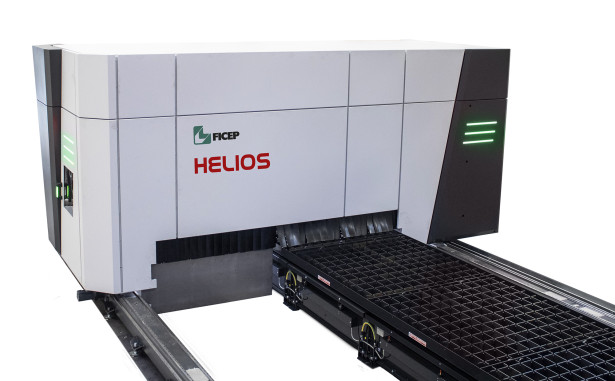
The manufacturer is introducing the Helios G as its second system. The machine is designed for laser processing of large-format and thick sheet metal, thereby complementing the Stingray G system, which is more geared toward a variety of workpiece shapes.
Helios G is designed for fiber lasers with a power output of up to 60 kW. According to the manufacturer, it can be used to cut sheet metal with thicknesses of up to 120 mm.
The machine design is optimized for thick-sheet metal processing. This includes, in particular, mechanical stability and the laser processing of large workpieces. Make’s modular architecture is also utilized in this system.
With Make, Ficep is combining the introduction of two new laser systems with an overarching concept for the development and use of industrial manufacturing equipment. The focus is on standardized and configurable machine architectures, the combination of different machining processes, and the ability to technically adapt existing systems throughout their lifecycle.
Web:
www.ficep.it