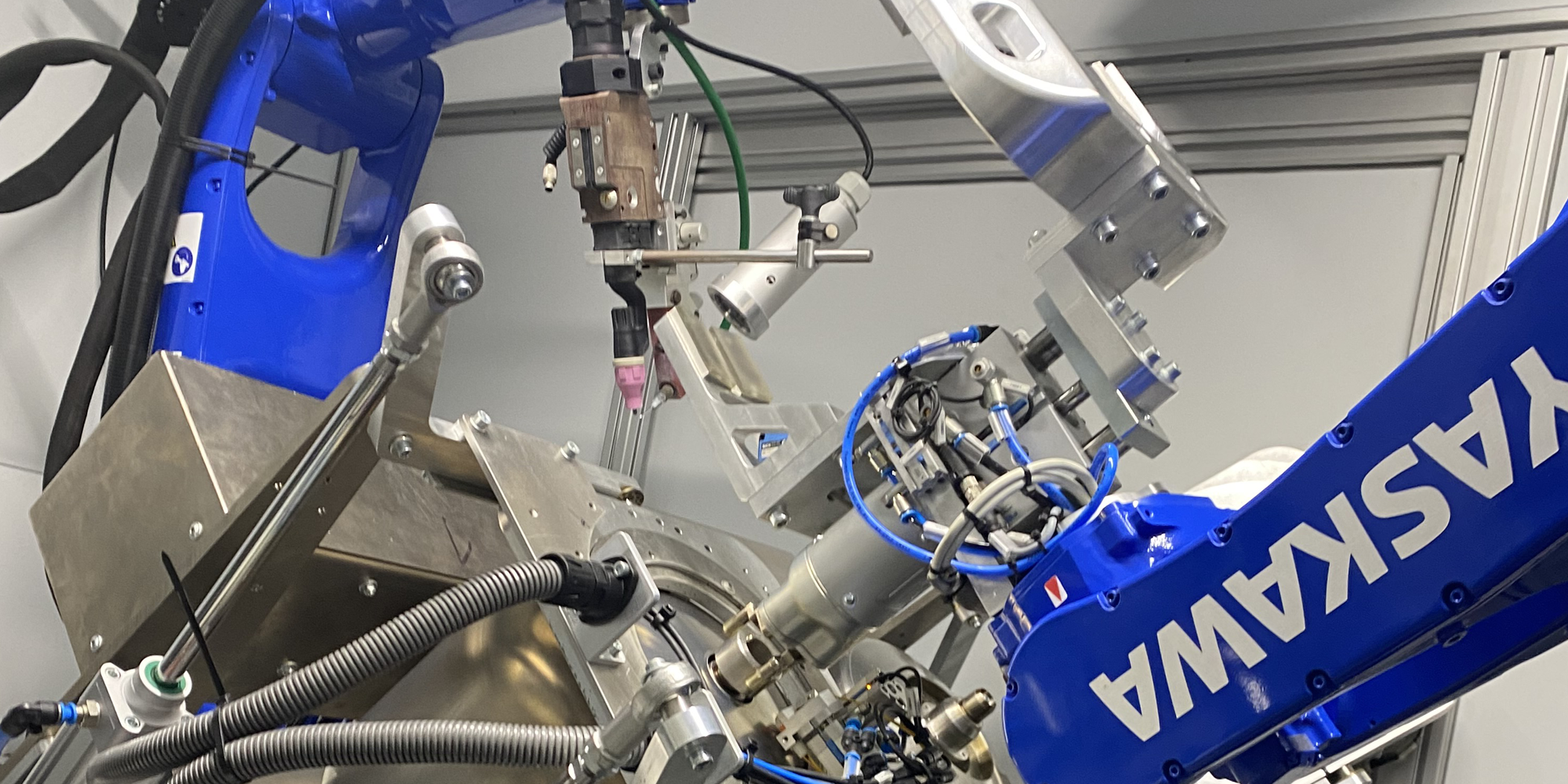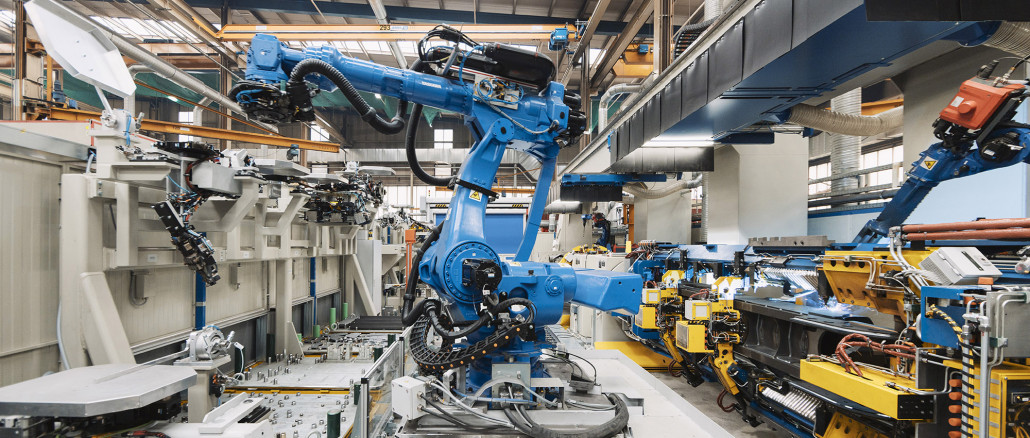
Fully automated production of complex component groups – the Liebherr Group has achieved this for the first time at its plant in Telfs (Tyrol). An autonomous production cell with three industrial robots handles all manipulation and joining processes right through to the ejection of the finished component.
It all began in 1949 with the invention of the tower crane. Today, the Liebherr Group, headquartered in Switzerland, is one of the largest manufacturers of construction machinery in the world. The demands in the production facilities are high, maximum quality standards and a very large vertical range of manufacture are a matter of course. At the same time, the company makes full use of the possibilities of automation.
© Liebherr
Growth through automation
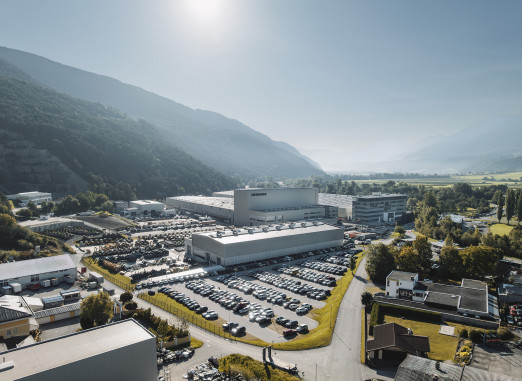
A look at the Austrian Liebherr plant in Telfs shows what this looks like in practice. There, in the Tyrolean Oberland, crawler dozers and loaders, telescopic handlers and pipelayers are being built. And there are plans to produce many more, as Jürgen Vizvary, Project Management Production at Liebherr Werk Telfs GmbH, explains: “We are pursuing a long-term goal at our plant: to produce over 3,000 machines per year.
To achieve this, we need to focus on automation in our plant development. In recent years, we have therefore invested in our site – including in a highly automated high-bay warehouse with space for 16,200 Euro pallets and 41,180 containers, as well as in the modernization of our assembly lines and steel construction facilities. We also want to keep our steel construction expertise in-house in the future, despite the shortage of skilled workers.”
As a “lighthouse project for the Liebherr Group’s earthmoving division in steel construction”, Vizvary and his colleagues have set themselves the task of automating the production of three different roller frames for bulldozers, which were previously tacked and welded manually. With high expectations, as the project manager says: “The approach was based on a high-performance concept: fully automated welding that enables high-energy and fully parameterizable welding processes. Another goal was to achieve maximum reproducible quality and at the same time to leverage optimization potential in component and welding processes. The focus here is on highly integrated, large components in medium quantities, i.e. around 500 units per year.”
A further requirement was to automate not only the tacking and joining processes, but also the handling of all components. In Vizvary’s words, this involves “a ‘colorful bouquet’ of steel components – from flame-cut and laser-cut parts to cast parts and raw materials with different manufacturing tolerances – which are ultimately combined to form a precise component.
© Liebherr
Fully automatic welding robot cell selected
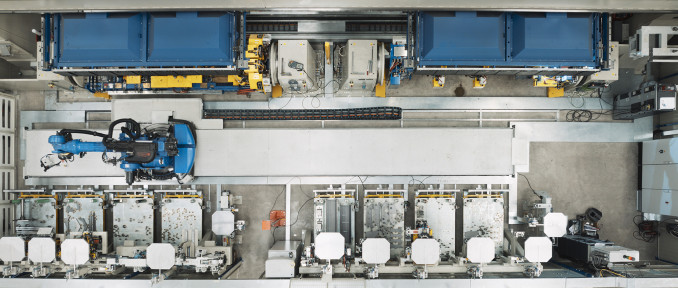
In the search for a suitable system for these tasks, the choice fell on a fully automatic welding robot cell from Yaskawa. The system concept combines a total of four work stations – two welding and two handling areas – on a footprint of around 22 × 8 m:
In the first station (welding area 1), a welding robot automatically tack welds and welds the components according to the appropriate welding sequence. A second welding robot then takes over the component for further processing in the second station (welding area 2).
The two welding robots are operated by a handling robot, which occupies the third station (handling zone). This picks up the corresponding individual parts from the various storage positions at the front of the cell. Mounted on a floor track, the handling robot can cover a large working area and easily reach all positions in the cell. The robot is equipped with different grippers for gripping the various individual components. These can be changed automatically. Finally, the fourth station of the fully automated cell (finished part handling) removes or conveys the finished parts via its own handling gantry, which is equipped with a special universal gripper.
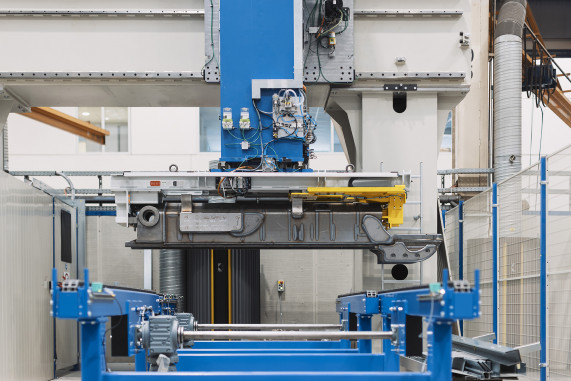
© Liebherr
Production increased by more than half
Thanks to pre-buffering and all the necessary safety precautions, this cell layout allows fully automatic operation, so that the third shift can even be run unmanned. Overall, the automation measures resulted in a production increase of more than 50%.
Yaskawa was not only responsible for the system concept. The company, which has its own production sites in Bavaria and Slovenia, also supplied the welding and handling robots, including positioners, welding tables and tracks.
The welding robots are two Motoman AR2010 industrial robots. The 6-axis robots are specially designed for the requirements of arc welding. With a working range of 2,010 mm and a payload of up to 12 kg, they are suitable for welding bulky and large components.
Each robot is equipped with a sidecar for transporting the wire drum spool and the power source as well as the torch service station. Both use a common floor track with a travel length of around 12 m, which is integrated into the robot controller as an external robot axis. A 6-axis Motoman GP600 with a 600 kg payload capacity from the GP series (“GP” stands for “General Purpose”) operates in the handling zone.
Gantry track with Yaskawa’s own drives
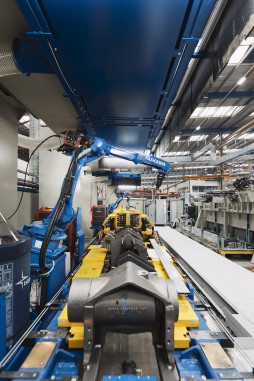
In both welding areas, two-part, solidly constructed turning positioning tables of type W5000 are installed, into which the components are clamped. The maximum load between the tips is 10,000 kg. Each of the four turners has its own drive, i.e. the turners are coupled in pairs as an “electric shaft”. Yaskawa also built the approximately 16 m long XZ gantry track and equipped it with drives from its own company.
The system is rounded off by the welding torch technology, the sensors and control technology as well as a specially designed extraction and filter system. This is equipped with two movable extraction hoods above the welding stations. This means that the hoods can be swung back so that the component can be removed via the unloading portal. Another special feature are two lifting devices for easy and safe changing of the welding rod drums.
© Liebherr
Automation project meets expectations
The decision in favor of Yaskawa was made as part of an evaluation process in which several providers were given the same task. The contract was awarded in 2022. “From day one, we had a highly professional team from Yaskawa at our side, who supported and guided us throughout the entire project phase,” says Project Manager Vizvary, looking back.
However, it was still some time before the project was completed: in the fall of 2025, the fully automated robot welding system from Yaskawa finally went into operation at the Liebherr plant in Telfs. Since then, it has fulfilled the expectations of Vizvary and his colleagues: “The new system enables the production of complex component groups in steel construction, in which all manipulation and joining processes up to the ejection of the finished component are fully automated. We can proudly say that we were part of a development that has rewritten a piece of automation history in steel construction,” summarizes the Liebherr project manager.
Web:
www.yaskawa.de