
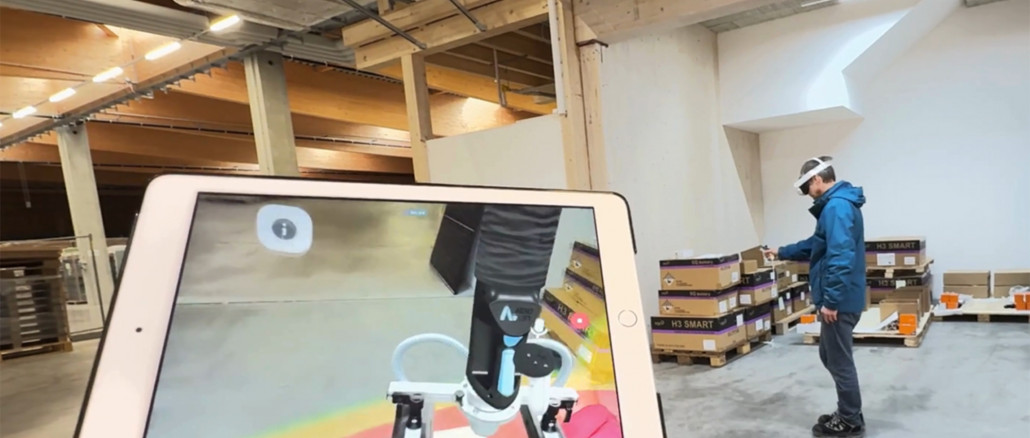
When designing vacuum handling systems, far-reaching decisions often have to be made early in the project. This is where one manufacturer uses virtual reality to work with users to more quickly identify what is important.
Often, only drawings or conceptual designs are available for such projects. Spatial conditions, motion sequences, and integration into production environments can only be inferred from these to a limited extent. The Binsdorf-based company Aero-Lift Vakuumtechnik GmbH is addressing this challenge in collaboration with partners from industry and research using virtual reality (VR). This technology makes it possible to visualize technical systems realistically even before implementation, thereby facilitating the consulting process.
The Ministry of Research funded the project
The VR application was developed as part of the “VR-Chain” research project, funded by the Federal Ministry of Research, Technology, and Space (BMFTR), which focused on the collaborative use of virtual reality along value chains. The goal was to develop new forms of collaboration across company boundaries and thereby make coordination processes more efficient. The VR application was implemented in a multi-year project in collaboration with partners from industry and research.
In addition to Aero-Lift, project participants included Vetter Krantechnik GmbH, the agency Lightshape, and scientific institutions such as the ISF Munich and the University of Bremen. At Aero-Lift, the VR application is now being integrated into the inquiry and quotation process. Following a technical analysis, a digital 3D model of the planned system is first created, which is then transferred to a virtual environment. There, customers, as well as Aero-Lift’s sales and engineering teams, can collaborate on the system. Systems can be explored at actual scale, variants can be compared, and workflows can be simulated.
The facility becomes more visible than it would be with drawings alone
“This allows us to create a basis for decision-making that goes far beyond traditional drawings. Our customers can experience their future facility even before it is built,” explains Tobias Pauli, CEO of Aero-Lift. Another advantage lies in the collaborative approach: Multiple project stakeholders can work simultaneously in the virtual environment and coordinate adjustments in real time. This allows them to optimize positioning, verify reach, or identify potential interference contours early on. Stakeholders can also immediately evaluate ergonomic aspects and accessibility without the need for time-consuming prototypes.
Early visualization reduces the coordination effort required in later project phases. Decisions are made on a more informed basis, misunderstandings are minimized, and iteration cycles are shortened. For Aero-Lift, this means more efficient project management; for the customer, it means, above all, greater transparency and certainty in the planning process.
Web:
www.aero-lift.de