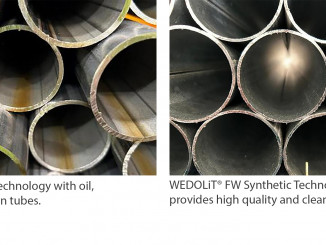
Large-diameter pipes must meet tight tolerances. Expanding is the critical step in achieving the required roundness and diameter. A novel formulation concept for expander lubricants makes this process more sustainable.
Large-diameter pipes form the foundation of modern energy and raw materials infrastructure. They are the central component of pipelines that transport oil, gas, water, or chemical products safely and cost-effectively over long distances. Their role in the industry is therefore of strategic importance: without high-performance pipe systems, the supply of energy and raw materials in globalized markets would be unthinkable.

© Master Fluid Solutions
Manufacturing as a Technical Challenge
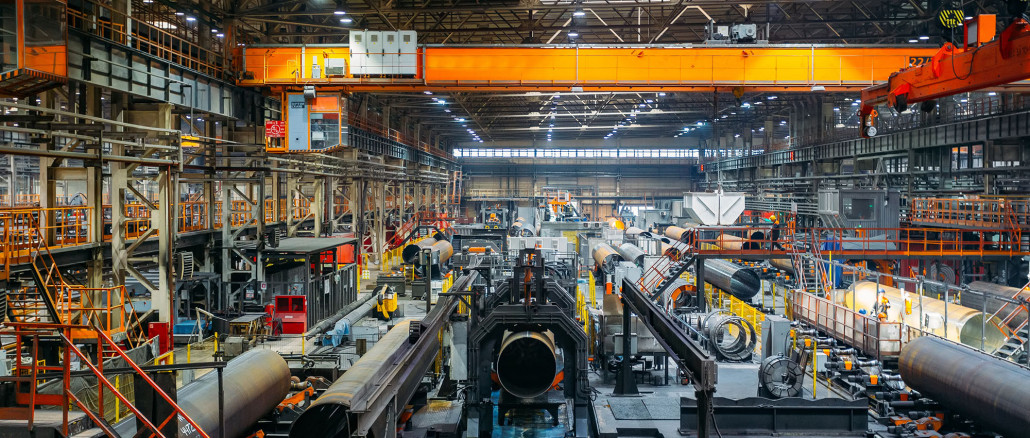
However, the manufacture of large-diameter pipes is a complex task. In addition to using suitable materials, precise manufacturing processes must be employed to ensure the required mechanical properties and corrosion resistance. Maintaining tight tolerances for diameter and roundness is particularly challenging. Furthermore, external factors such as increasing sustainability requirements, the processing of high-strength steels, and the integration of modern testing methods complicate production. The combination of technical complexity, economic pressure, and safety-related considerations makes the manufacture of large-diameter pipes a highly specialized field of industrial manufacturing.
Today, expansion is a critical step in the manufacturing process of large-diameter longitudinally welded pipes. This final forming step takes place after welding, during which the pipe is brought into its final shape through mechanical expansion. The goal is to improve dimensional accuracy and maintain the tolerances for roundness and diameter that are essential for high-pressure pipelines.
In practice, various methods are used, with fully automated full-body expanders now representing the state of the art. They enable uniform expansion along the entire length of the pipe, thereby ensuring high process stability. Processing high-strength steels is challenging, as there is a risk of cracking or uneven deformation. The weld seams must also withstand the stresses during the expansion process, which requires precise control of the process parameters.

© Master Fluid Solutions
Tribology in the Expansion of Large Pipes
The expansion of large pipes is not only a geometric calibration step but also a complex tribological problem. During expansion, significant contact forces act between the cone and the outer segments of the expander head. These high surface pressures can cause wear, which negatively affects both the expander’s service life and the quality of the pipe’s inner surface.
Expander lubricants are used to control these stresses. They form a stable lubricating film that reduces sliding friction while protecting the expander segments from wear. In addition, they help keep the inner wall of the tube technically smooth, which is important for media flow during subsequent operation. Uniform lubrication also ensures reproducible expansion forces, thereby reducing the risk of dimensional deviations and increasing process stability.
In addition, expander oils must not leave behind any residues that could interfere with subsequent testing or pipeline operation. Their thermal stability is critical, as they must maintain a defined viscosity profile and lubricating effect even at high forming temperatures.

© Zarana/stock.adobe.com
First- and second-generation expander lubricants
For a long time, their lubricating properties and raw material profile made ester-based expander oils the industry standard, which is why they remain among the most commonly used products in large-diameter pipe manufacturing, particularly with regard to sustainability. Mineral oil-based expander oils are also state-of-the-art today and are considered an alternative, as the further development of mineral oil-based formulations over time has focused specifically on improving those properties that could lead to increased cleaning requirements with ester-based products.
A fundamental problem with ester-based expander oils is their tendency to resinify. Natural triglycerides undergo oxidative reactions when exposed to high temperatures and pressure, such as those that can occur during the forming process. Under certain conditions, this can result in resinous, sticky residues that then accumulate on expander heads, machine components, and the inner surfaces of pipes. This results in increased cleaning and time requirements, which affect plant availability and thus the cost-effectiveness of the production process.
Mineral oil-based blowing agents, on the other hand, are less prone to such polymerization and oxidation reactions due to their saturated hydrocarbon structure. In industrial practice, this results in cleaner equipment and consistent process stability.
The washability of oil residues from pipe surfaces is directly linked to the tendency to resinify. Oxidatively modified ester components tend to be less soluble and may require more extensive cleaning to remove. Since a clean pipe surface is an essential prerequisite for subsequent process steps such as internal coatings, corrosion protection systems, or pipe welding, reduced washability may impair the process flow. In contrast, mineral oil-based expander oils remain easily washable even after heavy use and prolonged storage. Their higher oxidation stability prevents the oil from thickening or sticking, making them easier to rinse out and ensuring that surface quality remains consistent.
In practice, cleaning is usually performed using multi-stage flushing cycles with water or a low-concentration oil-water emulsion, which are integrated into the production line. First, the inside of the pipe is flushed with high-pressure nozzles to remove lubricant residues and particles. This is followed by rinses with tempered water, which promotes the formation of oil-water emulsions and facilitates the removal of lubricants from the metal surface. To this end, emulsifiers are added to the expander lubricants, which break the oil down into finely dispersed droplets, thereby enabling complete cleaning. For the expander heads themselves, spray systems are frequently used to prevent deposits.
Ester-based emulsions sometimes exhibit a slightly increased tendency toward phase separation. As a result, free oil droplets may remain on the inner and outer surfaces of the pipes, which, if cleaning is inadequate, increases the risk of adhesion problems in subsequent coating processes.
Mineral oil-based expander oils, on the other hand, feature optimized emulsifier systems that ensure a stable emulsion even under fluctuating process parameters, varying water qualities, and high temperatures. This ensures uniform wetting of the tubes, reduces oil separation, and increases process reliability in subsequent manufacturing steps.

© Mulderphoto/stock.adobe.com
Water recovery through emulsion breaking
However, these oil-water emulsions pose both an environmental and an economic problem, as they cannot be disposed of without treatment. In practice, therefore, emulsion separation systems are used to process the emulsions so that the phases can be separated and reused. These separation systems operate on the principle of chemico-physical separation. By adding separation agents, such as iron or aluminum salts as well as flocculants, the stability of the emulsion is disrupted. The oil phase coagulates and separates from the water. This is followed by sedimentation or flotation, resulting in two clearly distinguishable phases: purified water and oil flocs.
After treatment, the treated water has significantly reduced contamination and can be returned to the production cycle as rinse water. This reduces the demand for fresh water, which not only conserves resources but also results in cost savings.
Similar separation results can be achieved using organic separation agents. However, the aqueous phase is contaminated with the separation agents, so it cannot be recycled back into the process. The separated oil phase contains concentrated organic components with a high calorific value. Instead of disposing of it as hazardous waste, the oil phase can be sent for thermal recovery. In suitable incineration plants, it serves as a substitute fuel, thereby replacing fossil fuels. This contributes to the energy efficiency of the overall production process and improves the carbon footprint.
Third-generation expander lubricants
A newly developed formulation concept for expander lubricants by Master Fluid Solutions represents a breakthrough in the splitting of expander oil emulsions. At the heart of the Easy-Splitting Technology is the integration of a functional “predetermined breaking point” into the molecular structure of the emulsifier used. This minimizes the need for specially formulated separation media whose mechanism of action is tailored to the new lubricant concept. At the same time, nearly complete separation of the oil and water phases is achieved, surpassing the performance of conventional systems. The separated water exhibits high optical clarity and is free of visible residues, enabling its immediate return to the process loop.
Modern expander lubricants form a stable lubricating film that reduces sliding friction, thereby protecting the expander segments from wear and ensuring that the inner walls of the tubes remain technically smooth. Reproducible expansion forces reduce the risk of dimensional deviations and increase overall process stability. Mineral oil-based expander lubricants can also be easily cleaned with water thanks to optimized emulsifier systems, and the water can be partially recovered in separation plants. With the help of Wedolit Easy-Splitting Technology, virtually complete separation of the oil and water phases is achieved with minimal use of splitting media. As a result, the recovered water can be immediately returned to the process cycle, drastically reducing the demand for fresh water.
Web:
www.masterfluids.com