
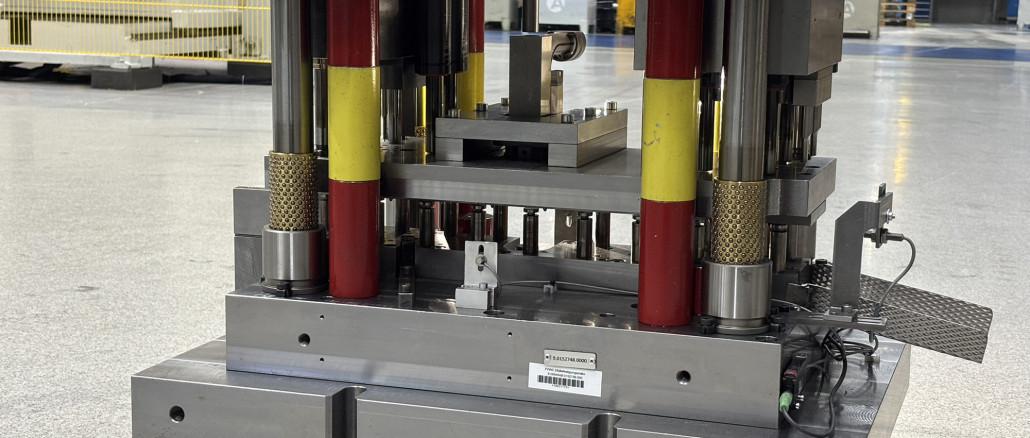
When threaded bolts or screws are inserted into the sheet metal during forming, this expands the design possibilities. A new generation of press-in heads enables higher cycle rates.
If, on the other hand, screws or threaded bolts are inserted manually only after forming, this requires additional steps—which affect cycle time and costs. This is where the press-fitting of screws in the forming die comes into play: Integrating the insertion process into the pressing process saves time and costs without limiting design flexibility. A new generation of press-in heads enables higher cycle rates while offering the flexibility needed to meet customer-specific requirements in tooling.
Depending on the size of the press, modern pressing plants operate at more than 60 strokes per minute. Press-fitting screws within these cycles requires a deep understanding of the process and system engineering. The specialists at Arnold Bluefastening Systems have drawn on their experience to further develop the press-in heads. The goal was to ensure functionality even at maximum cycle rates and to enable use in the confined spaces of a forming die. Combined with feeding systems, this creates a complete solution for press shops.
© Arnold Umformtechnik
Press-fit screws and sheet metal forming in a single operation
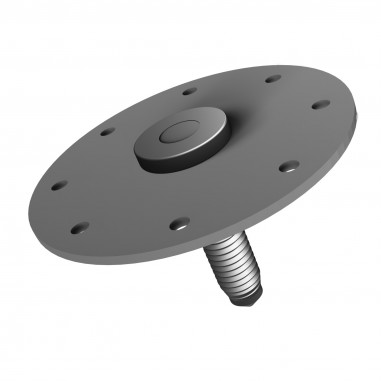
Press-fit systems handle tasks in sheet metal forming for a wide variety of applications, so to speak, as a side benefit. The range of applications extends from large-format sheet metal for cladding railroad cars or buses, to automotive body panels and household appliances, all the way to small-format steel sheet parts that are subsequently processed into closed hollow bodies. Press-fitting technology also opens up new possibilities in electrical engineering. Here, for example, battery and rechargeable battery packs can be manufactured, or connections can be attached to lightweight molded parts for microvehicles, industrial trucks, or e-bikes. Even busbars—that is, current-carrying rails made of copper, aluminum, and their alloys—can be formed and fitted with connection components simultaneously.
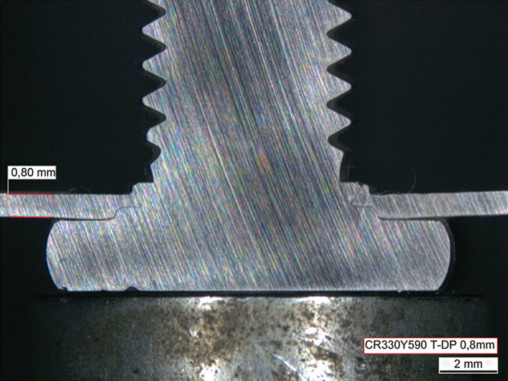
Sheet thickness plays virtually no role in this process; even multiple layers of sheet metal or steels with strengths up to 900 MPa can be fitted with press-in screws. At the same time, intermediate steps such as cleaning the sheets before the welding process or removing weld spatter and oxidation layers afterward are eliminated. Unlike welding, there are no smoke, odor, or vapor emissions that require ventilation.
Digital Twin Simplifies Planning
Investments in press shops—including press-fit heads, dies, and feeding systems—are expensive. This makes it all the more important to have a realistic forecast of performance, particularly in terms of possible cycle rates. Since applications vary widely, Arnold models the sorting and feeding process in the conveyor system as a digital twin. Based on this, various scenarios can be simulated. The fastener specialists offer a complete system from a single source: from the press-fit tool and the feeding unit to press-fit screws that are, in some cases, custom-designed. For example, the new compact V6 press-fit head variant can be used at up to 60 strokes per minute. Replacing older generations of press-fit heads with the V6 requires only minor adjustments to the forming tool. Existing feeding components, such as the Segment Air Feeder, can continue to be used; only the software needs to be adapted to the higher feed rates.
A key factor is the easy integration of the systems into existing presses. Measuring 70 × 172 × 180 mm (W × H × L), the new design can also operate multiple press-in heads in parallel. This enables high output rates even when multiple screws are processed per cycle. Process speeds are increased by directly buffering the screws in the insertion head. Instead of transporting each screw individually via compressed air, two to four screws—depending on the screw size—are buffered together inside the feed hose. This batch transport ensures that screws are available at the insertion point even at high cycle rates and reduces compressed air consumption.
© Arnold Umformtechnik
Pneumatic conveyor protects the screws
Despite its compact design, the modular press-fit head is easy to disassemble and clean. Downtime is minimized from the outset—in part thanks to the Segment Air Feeder with a segment blade for sorting screws. Unlike vibrating conveyor systems, where screws rub against each other and cause abrasion—especially on coated threads—the segment blade gently sorts the fasteners. Material wear is minimal, and the effort required to clean the feeding and press-in components is reduced.
The press-in heads are suitable for nearly all types of sheet metal and materials, largely regardless of sheet thickness, screw length, or diameter. Currently, screws in sizes M5, M6, and M8 from the Rivtex, Strux, and Strux HM product families can be processed; performance data is based on tests with M8 screws. For smaller presses, the feeder is roller-mounted and can be flexibly positioned. For larger systems, it can be installed on the press table. Customer service, with a focus on rapid spare parts supply, ensures high system availability. Special components are manufactured using additive manufacturing and are therefore available as spare parts on short notice.
Julian Eder, Test Center / Service Feedtec & Tooltec Arnold Umformtechnik, and Andreas Zeiff, Stutensee Editorial Office
